
Introduction
There's a particular moment every creator knows. You launch an AI image, you wait for the render, and when it appears, something feels off. Everything seems technically correct: the subject is there, the colors are pleasant, the composition is balanced. Yet the image feels hollow, like a scene without a heartbeat. It doesn't look like a frame from a film. It looks like an illustration trying to imitate one.
And then, on other days, the opposite happens. The image appears and it feels alive. It looks like a fragment of a story already unfolding somewhere beyond the frame. You can almost sense the air in the scene, imagine the soundscape, guess what happened a moment before or what might happen next. It feels intentional, as if someone had placed the camera there for a reason. That difference rarely comes from the model alone. It comes from the prompt.
Most people write prompts the way they jot down a grocery list. A handful of adjectives, a few nouns, maybe a style reference, and the hope that the model will magically assemble something cinematic. But cinema doesn't work through accumulation. Cinema works through choices. Through clarity. Through the decision to show one thing instead of another.
Writing prompts that look like movie scenes isn't about pretending to be a cinematographer or memorizing technical jargon. It's about learning to think visually. It's about guiding the model the way a director guides a crew: with intention, with a sense of atmosphere, and with an understanding of what the viewer should feel.
In this article, I'll share a simple method that anyone can use. Five elements that, when combined, give your prompts the structure and coherence of a real cinematic shot. You don't need expertise. You don't need complex terminology. You just need a way of thinking that brings your images closer to storytelling rather than decoration. Once you understand how these five elements interact, your prompts will stop being descriptions and start becoming scenes.
What Makes an Image Feel Cinematic
Before we talk about prompts, it helps to understand why some images feel cinematic in the first place. It's not just about dramatic lighting or a wide aspect ratio. Cinema has a way of shaping the viewer's attention that goes far beyond aesthetics. A cinematic image carries intention. It suggests a world that continues outside the frame. It feels like a moment chosen, not a moment that simply happened.
When you look at a movie shot, you rarely think about the technical decisions behind it. You don't consciously analyze the lens, the angle, or the lighting setup. Yet your brain registers all of it. It recognizes depth, scale, atmosphere, and emotional cues. It senses that the camera is placed where it is for a reason. That sense of purpose is what separates a cinematic frame from a random snapshot.
AI models, surprisingly, respond to the same cues. They don't "understand" cinema the way a filmmaker does, but they react to patterns. They recognize that certain combinations of subject, camera, lighting, mood, and environment tend to produce images that resemble film language. When these elements align, the model generates something that feels coherent, as if it belongs to a larger narrative.
The opposite is also true. When a prompt lacks structure, the model fills the gaps with generic assumptions. The result is often an image that looks like a collage of ideas rather than a scene. The subject floats without context. The lighting feels disconnected from the mood. The environment looks like a backdrop instead of a world. Nothing is wrong, but nothing is compelling either.
Cinematic images work because they create a sense of presence. They make you feel like you're standing somewhere, witnessing something. They give you a point of view. They give you atmosphere. They give you a reason to care. And that is exactly what a good prompt should aim to do: not describe an image, but evoke a moment.
Once you understand this, the rest becomes much easier. You don't need to think like a technician. You just need to think like someone who wants to show something meaningful. The tools are simple. The magic comes from how you combine them.
The Five-Step Method: Subject, Camera, Lighting, Mood, Environment
If you've ever watched a director on set, you'll notice something interesting. They don't describe images the way most people write prompts. They don't say "make it dramatic" or "make it cinematic." They talk in concrete terms. They talk about what the camera sees, how the light behaves, what the character is doing, and what the space around them feels like. They build a scene piece by piece, not by piling adjectives on top of each other.
This five-step method comes from that way of thinking. It's not a formula. It's a way of organizing your imagination so the model has something solid to work with. Think of it as the skeleton of a cinematic moment. Once you have the structure, you can dress it however you want.
Let's explore each element.
1. Subject: The Anchor of the Scene
Every cinematic moment begins with someone or something worth looking at. The subject is the anchor. Without it, the image floats. Too many prompts start with vague ideas like "a beautiful scene" or "a dramatic moment," but cinema doesn't work with abstractions. It works with specifics.
A subject can be a person, an object, an action, or even a relationship between things. What matters is clarity. The more clearly you define what the viewer should focus on, the more intentional the image becomes.
A few examples that work well:
- A young woman catching her breath after running
- An old detective lighting a cigarette under the rain
- A child holding a lantern in a dark forest
- A robot repairing a broken panel on its own chest
Notice how each subject contains a small spark of story. Not a full narrative, just enough to suggest movement or purpose. AI models respond extremely well to this kind of specificity because it gives them a direction instead of a cloud of possibilities.
When the subject is clear, everything else becomes easier.
2. Camera: The Invisible Narrator
If the subject is the anchor, the camera is the narrator. It decides how the viewer enters the scene. A low angle makes a character feel powerful. A high angle makes them vulnerable. A close-up reveals emotion. A wide shot reveals context. A long lens compresses space. A wide lens exaggerates it.
Most people underestimate how much the camera influences the emotional tone of an image. They describe what they want to see, but not how they want to see it. Yet in cinema, the "how" is often more important than the "what."
Here are a few camera choices that instantly add cinematic weight:
- Low-angle medium shot
- Wide 35mm shot from behind the character
- Close-up with an 85mm lens
- Over-the-shoulder shot with shallow depth
These aren't technical instructions. They're emotional cues. They tell the model how to position the viewer inside the moment. They create perspective, depth, and intention.
Once you start thinking in terms of camera placement, your prompts stop being descriptions and start becoming scenes.
Learn more about camera angles, depth of field, lens types, and shot types.
3. Lighting: The Sculptor of Emotion
Lighting is where most cinematic images either succeed or fall apart. Light shapes the subject, defines the atmosphere, and guides the viewer's eye. It can soften a moment or sharpen it. It can reveal or conceal. It can make a scene feel safe, dangerous, intimate, or surreal.
You don't need to know the physics of light to use it well. You just need to understand how different types of light feel.
Some examples:
- Soft diffused morning light
- Warm sunset backlight
- Harsh directional light with deep shadows
- Neon reflections from nearby signs
- Cool rim light outlining the character
Each of these choices carries emotional weight. Soft light feels gentle. Hard light feels tense. Backlight feels dramatic. Neon feels stylized. Rim light feels sculptural.
When you choose the lighting, you're not just describing brightness. You're shaping the emotional temperature of the scene.
Explore lighting techniques in more detail.
4. Mood: The Emotional Filter
Mood is the quiet force behind every cinematic image. It's the emotional filter that colors the entire scene. You don't need complex vocabulary here. In fact, simple words often work best because they leave room for interpretation.
A few moods that consistently produce strong results:
- Dramatic
- Mysterious
- Nostalgic
- Tense
- Peaceful
- Melancholic
Mood is where your intention becomes clear. It tells the model what the viewer should feel, not just what they should see. It's the difference between a forest that feels magical and a forest that feels threatening. The same environment, the same subject, but a completely different emotional experience.
When mood aligns with lighting and camera, the image gains coherence. It stops being a collection of elements and becomes a moment.
5. Environment: The World Around the Moment
Finally, the environment. This is where the scene breathes. It's the space that surrounds the subject and gives context to the moment. Without it, the image feels like a portrait. With it, the image feels like a story.
The environment doesn't need to be described in detail. A few well-chosen words are enough to suggest a world.
Examples:
- A foggy nighttime street
- A quiet suburban neighborhood at dawn
- A neon-lit alley in a futuristic city
- A deserted beach during golden hour
- An abandoned warehouse filled with dust
The goal isn't to overwhelm the model with information. It's to give the scene a place to exist. A cinematic image always feels like it belongs somewhere. The environment is what makes that possible.
Bringing It All Together
When you combine these five elements, something interesting happens. The prompt stops feeling like a list and starts feeling like a shot description. It gains rhythm. It gains intention. It gains a sense of presence.
Subject gives you the focus. Camera gives you the perspective. Lighting gives you the atmosphere. Mood gives you the emotion. Environment gives you the world.
Together, they form the backbone of a cinematic moment.
How to Assemble a Cinematic Prompt
Once you understand the five elements, the real magic begins when you start weaving them together. A cinematic prompt isn't a checklist. It's not meant to feel like a technical form you fill out. It should read like a small fragment of a scene, something that carries intention and rhythm. The structure is there to guide you, not to cage you.
Think of it the way a director speaks to a cinematographer. They don't say "subject, camera, lighting, mood, environment" in that order. They speak in images. They describe what they want the viewer to feel, then they shape the shot around that feeling. Your prompt should follow the same logic. The five elements are simply the tools you use to build that moment.
The key is flow. A good prompt moves from the essential to the atmospheric. It starts with clarity and ends with texture. It doesn't rush. It doesn't overload. It guides the model step by step into the world you're imagining.
Here's a simple way to think about it: start with what matters most, then reveal the rest as if you were painting the scene in front of someone who can't see it yet.
Begin with the subject. This is your anchor, the thing the viewer should care about. Then introduce the camera, because the way we look at something changes what it means. After that, bring in the lighting, which shapes the emotional temperature of the moment. Once the light is set, the mood becomes clear. And finally, place everything inside an environment that feels believable.
When you assemble the elements in this order, the prompt naturally gains coherence. It reads like a shot description rather than a list of attributes. It feels intentional, which is exactly what the model needs to produce something cinematic.
Let's look at a simple example of how this assembly works in practice. Imagine you want a dramatic scene featuring a character in motion. You might start with the subject: a woman running. Then you decide how the viewer sees her: a wide 35mm shot from behind. Next, you choose the lighting: soft morning light filtering through trees. The mood follows naturally: tense but hopeful. And finally, you place her somewhere: a quiet suburban street at dawn.
When you read it back, it doesn't feel like a prompt. It feels like a moment. And that's the goal. You're not describing an image. You're describing a scene that happens to be frozen in time.
The biggest mistake people make is trying to cram too much into a single prompt. They add every detail they can think of, hoping the model will sort it out. But cinema thrives on clarity, not clutter. A single strong idea is more powerful than ten competing ones. When you assemble your prompt, focus on the essentials. Let the model breathe. Let the scene breathe.
Another common mistake is forgetting the viewer. A cinematic image is always created for someone to look at. It has a point of view. It has intention. When you assemble your prompt, imagine you're standing behind the camera. Imagine you're choosing the angle, the distance, the moment. This mental shift alone can transform the way you write.
The beauty of this method is that it scales. You can keep it simple or make it more elaborate depending on what you need. But the foundation remains the same: subject, camera, lighting, mood, environment. Once you internalize this structure, assembling a cinematic prompt becomes almost instinctive. You stop thinking in terms of "what words should I add" and start thinking in terms of "what moment am I trying to capture."
And that's when your prompts stop being instructions and start becoming storytelling.
10 Cinematic Prompt Examples and Why They Work
Examples are where theory becomes instinct. You can read about subjects, cameras, lighting, moods, and environments all day, but the moment you see them working together, something clicks. You start to feel how a cinematic prompt breathes. You start to sense the rhythm. And once that rhythm becomes familiar, you can improvise with confidence.
The following ten prompts aren't meant to be copied blindly. They're meant to show how the five elements interact, how they support each other, and how a simple idea can turn into a moment that feels like it belongs in a film. After each example, I'll explain why it works, not from a technical standpoint, but from the perspective of someone trying to capture a fragment of a story.
1.
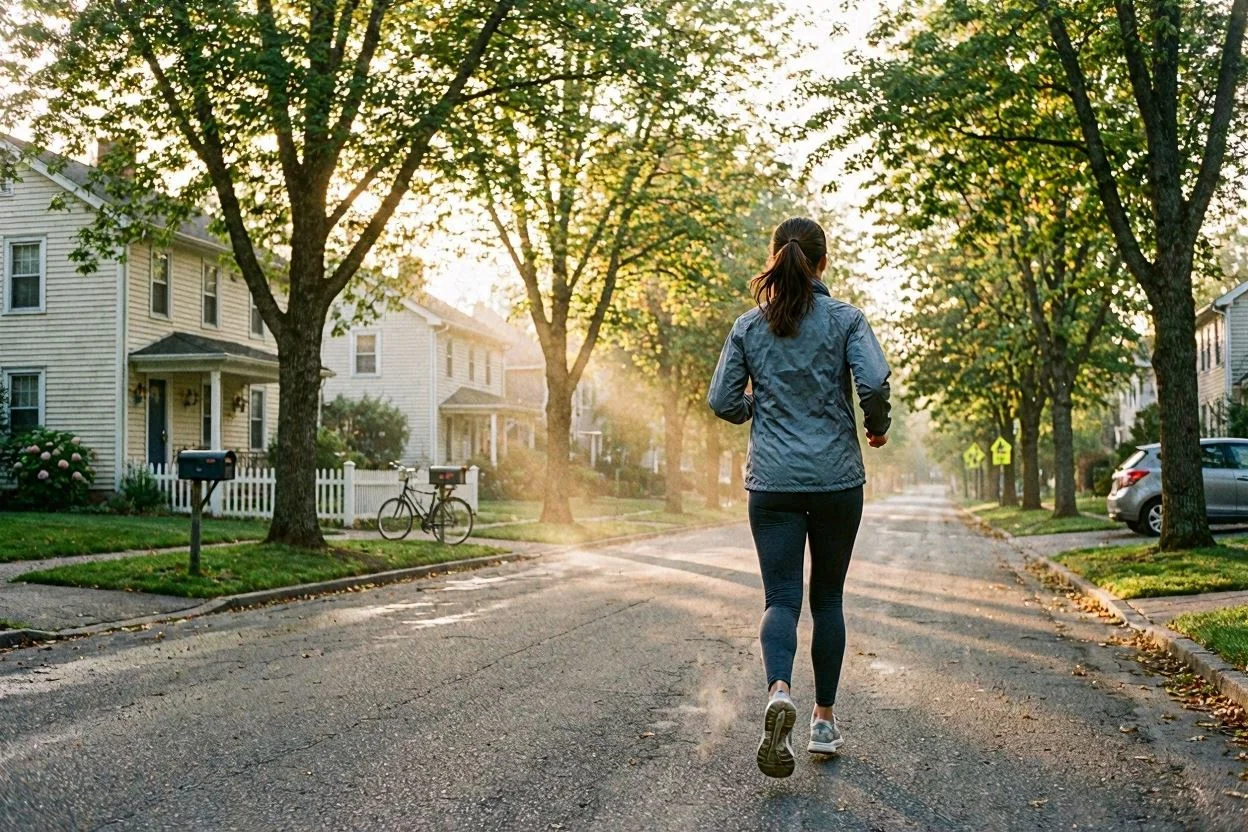
"A young woman running, wide 35mm shot from behind, soft morning light filtering through trees, tense but hopeful mood, on a quiet suburban street at dawn."
This prompt works because it balances motion and stillness. The woman is moving, but the world around her is calm. The wide lens gives the scene space to breathe, and the morning light adds a sense of renewal. The mood is emotional without being melodramatic. It feels like the opening of a coming-of-age film.
2.
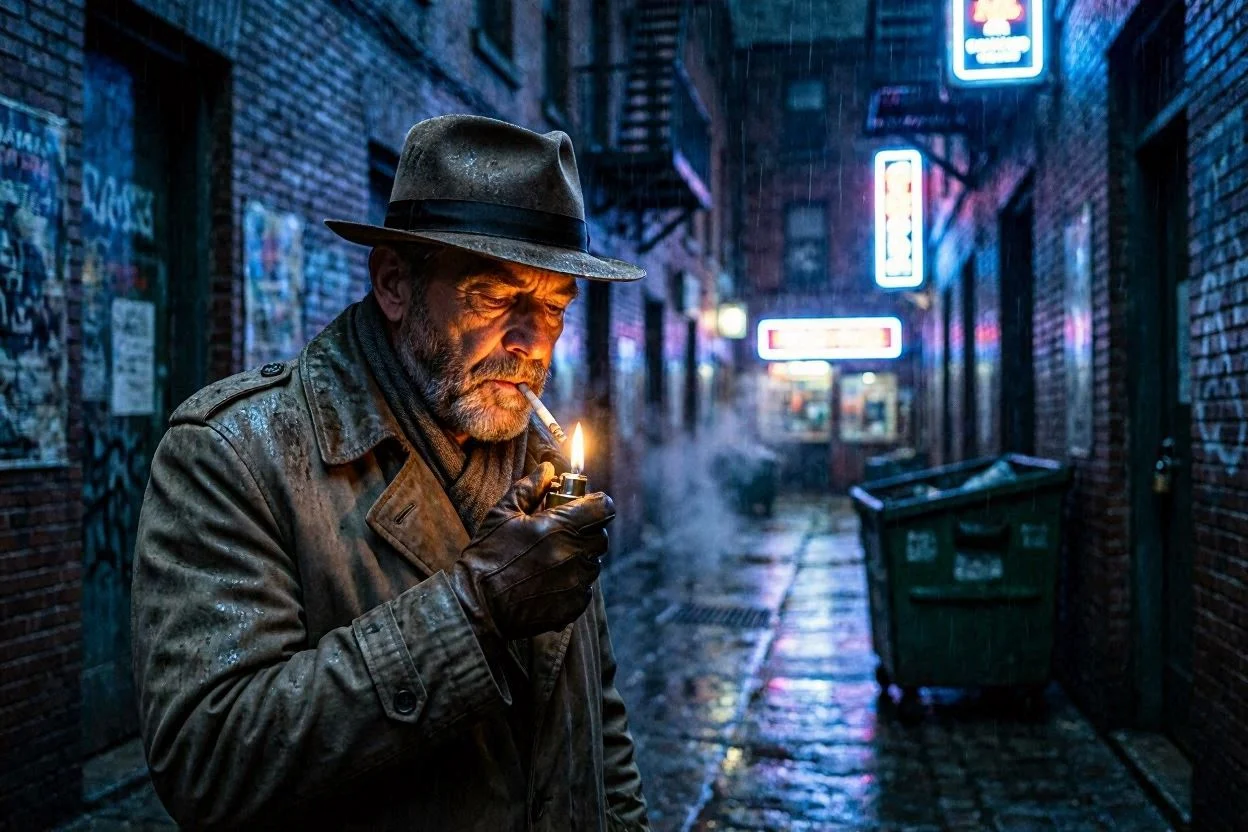
"An old detective lighting a cigarette, low-angle medium shot, harsh neon reflections on wet pavement, weary and introspective mood, in a narrow alley of a rainy city."
Here, the camera does most of the storytelling. A low angle gives the detective weight, but the neon reflections and wet pavement soften the scene with atmosphere. The mood is introspective, almost resigned. It feels like a moment between two chapters of a noir story.
3.
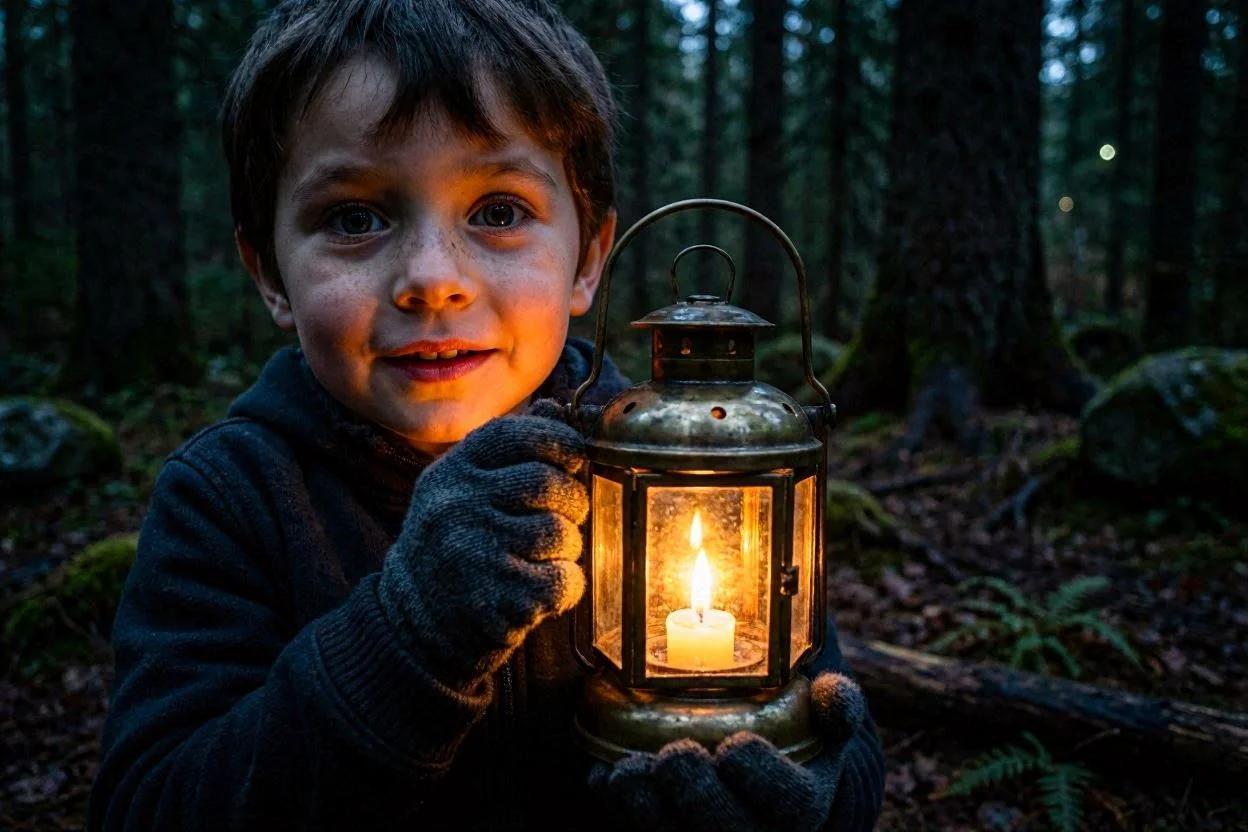
"A child holding a lantern, close-up with shallow depth, warm flickering light on their face, curious and slightly anxious mood, inside a dark forest clearing."
This prompt works because it isolates the subject. The close-up and shallow depth create intimacy. The lantern light adds warmth in an otherwise cold environment. The mood is a blend of wonder and fear, which is a powerful cinematic combination.
4.
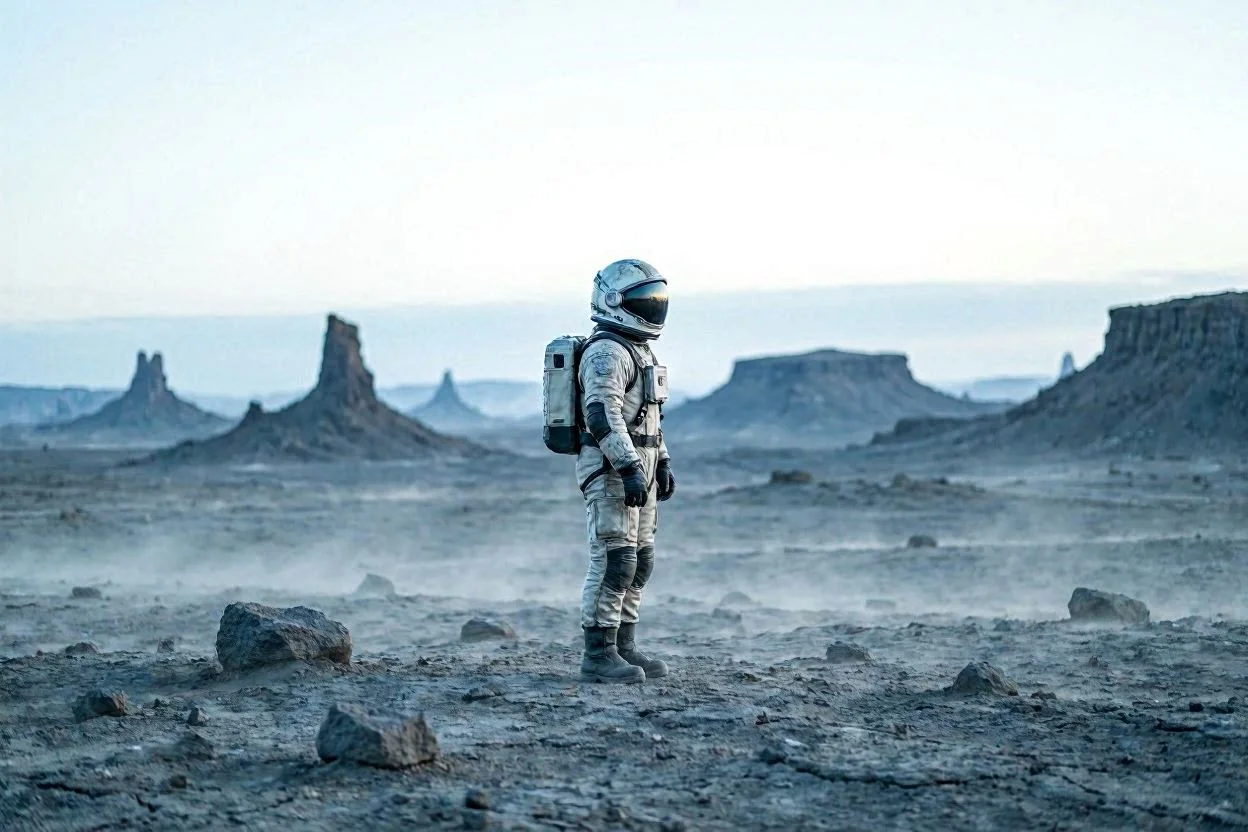
"A lone astronaut standing still, wide shot with a long lens, cold rim light outlining the suit, quiet and contemplative mood, on a desolate alien landscape under a pale sky."
The contrast between the long lens and the wide shot creates a sense of distance. The astronaut feels small, but not insignificant. The rim light adds a sculptural quality, and the environment reinforces isolation. It feels like a reflective moment in a sci-fi drama.
5.
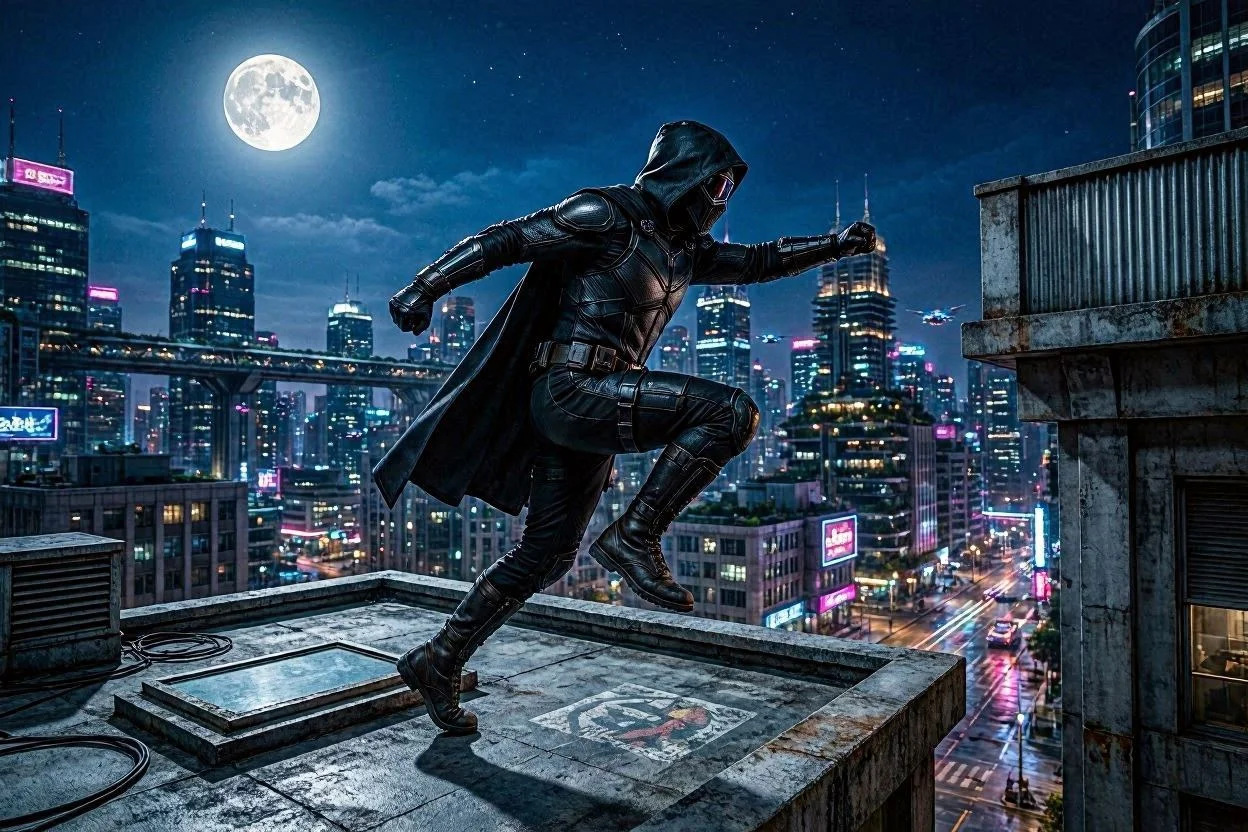
"A masked hero leaping between rooftops, dynamic low-angle shot, sharp moonlight casting long shadows, energetic and dramatic mood, above a dense futuristic city."
This prompt succeeds because it embraces movement. The low angle amplifies the leap, and the moonlight sharpens the silhouette. The environment adds scale and stakes. It feels like a frame pulled from an action sequence.
6.
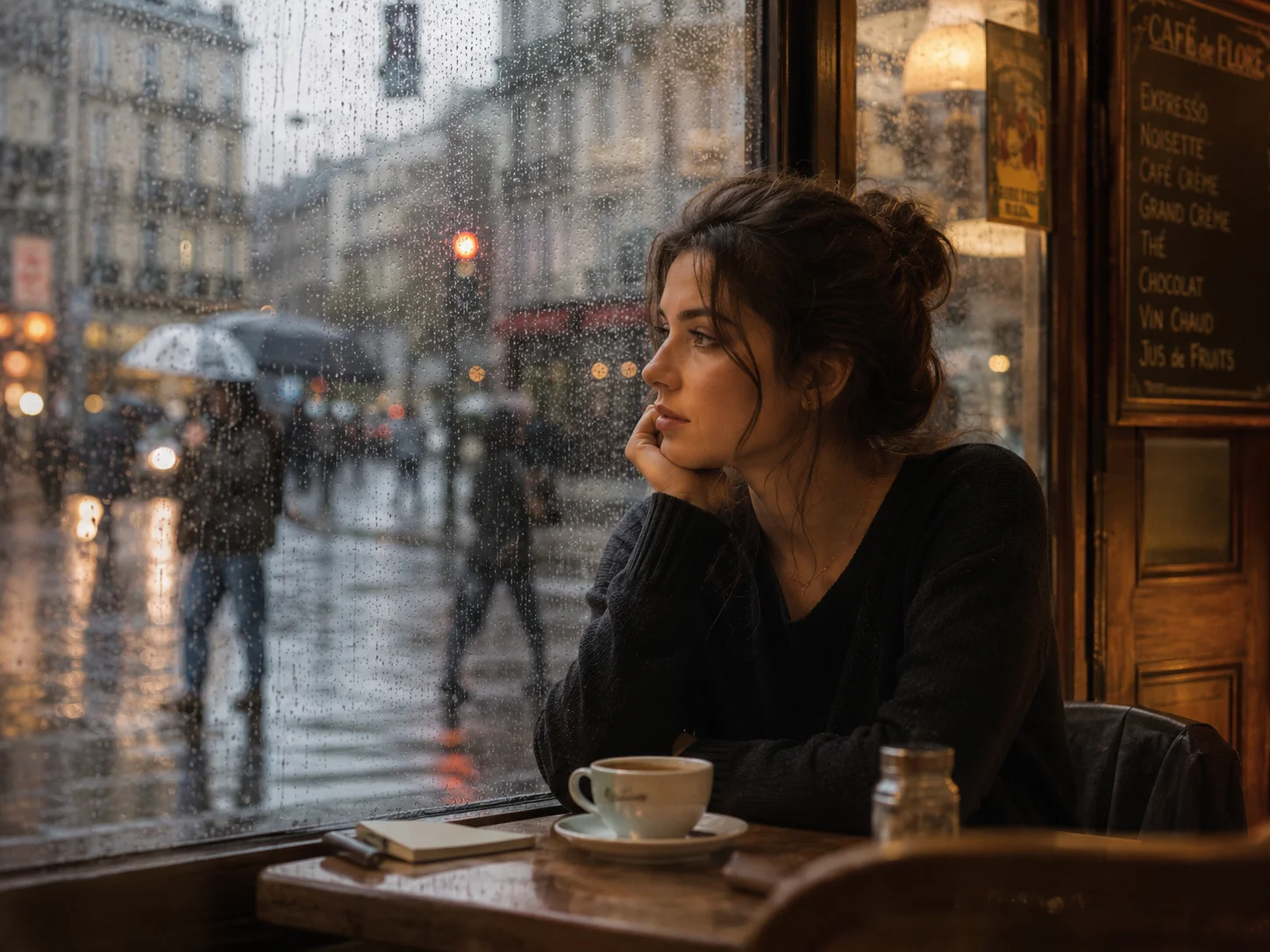
"A woman sitting alone in a cafe, medium shot through a rain-streaked window, soft warm interior light, nostalgic and quiet mood, on a busy street blurred in the background."
The power of this prompt lies in the window. Shooting through glass adds layers: reflections, distortions, a sense of separation. The warm interior light contrasts with the cold rain outside. The mood is nostalgic, almost reflective. It feels like a moment of pause in a character-driven film.
7.
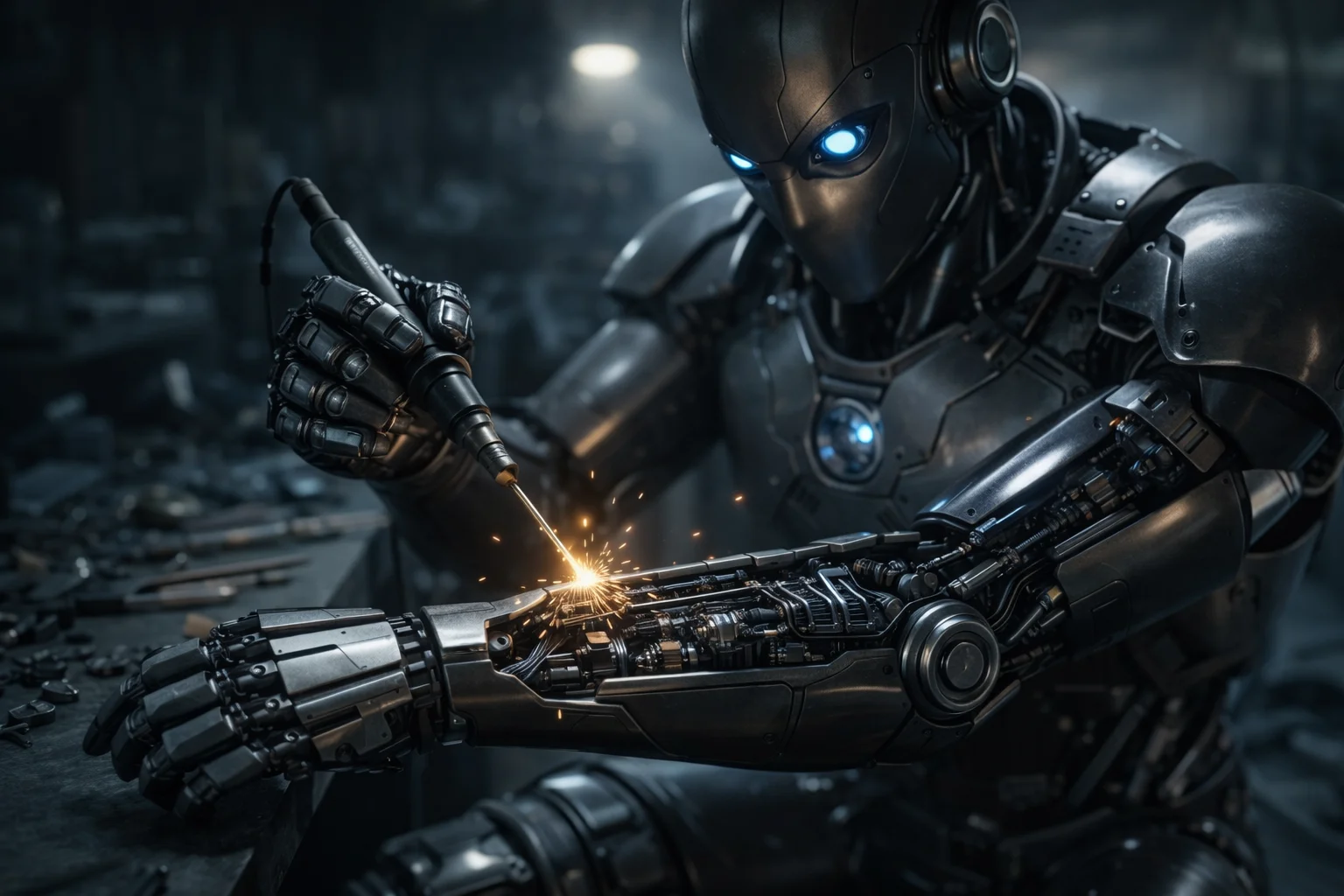
"A robot repairing its own arm, close-up 85mm lens, cool industrial lighting, focused and mechanical mood, inside a dimly lit workshop filled with scattered tools."
This example works because it blends precision and atmosphere. The close-up emphasizes the mechanical detail, while the environment adds narrative context. The lighting reinforces the cold, utilitarian mood. It feels like a scene from a grounded sci-fi story.
8.
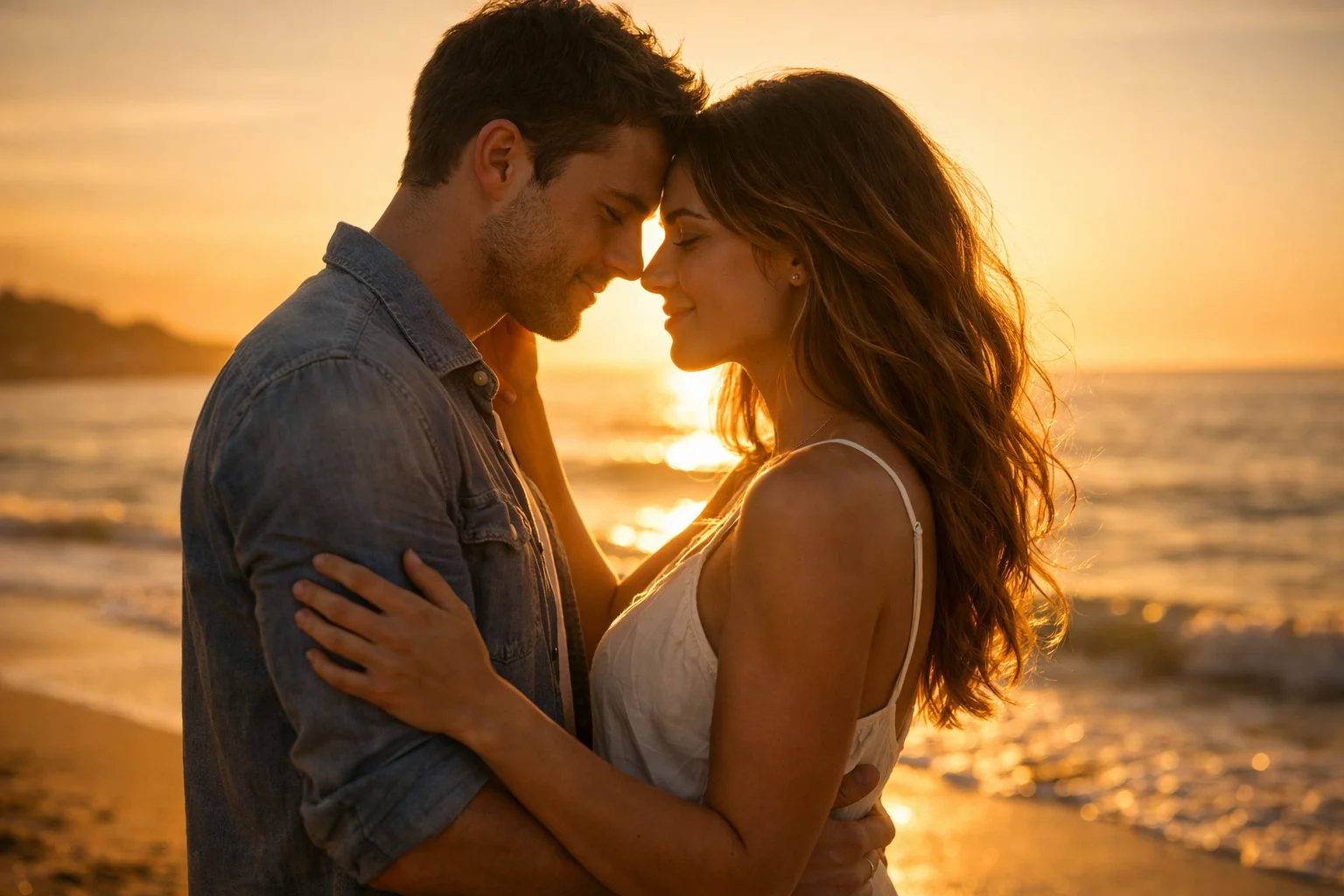
"Two lovers standing face to face, medium shot at eye level, golden hour backlight wrapping around them, warm and intimate mood, on a quiet beach with gentle waves."
This prompt succeeds because it embraces simplicity. The camera is neutral, the lighting is soft, and the environment is peaceful. Nothing is forced. The mood emerges naturally from the combination of elements. It feels like a romantic moment captured without artifice.
9.
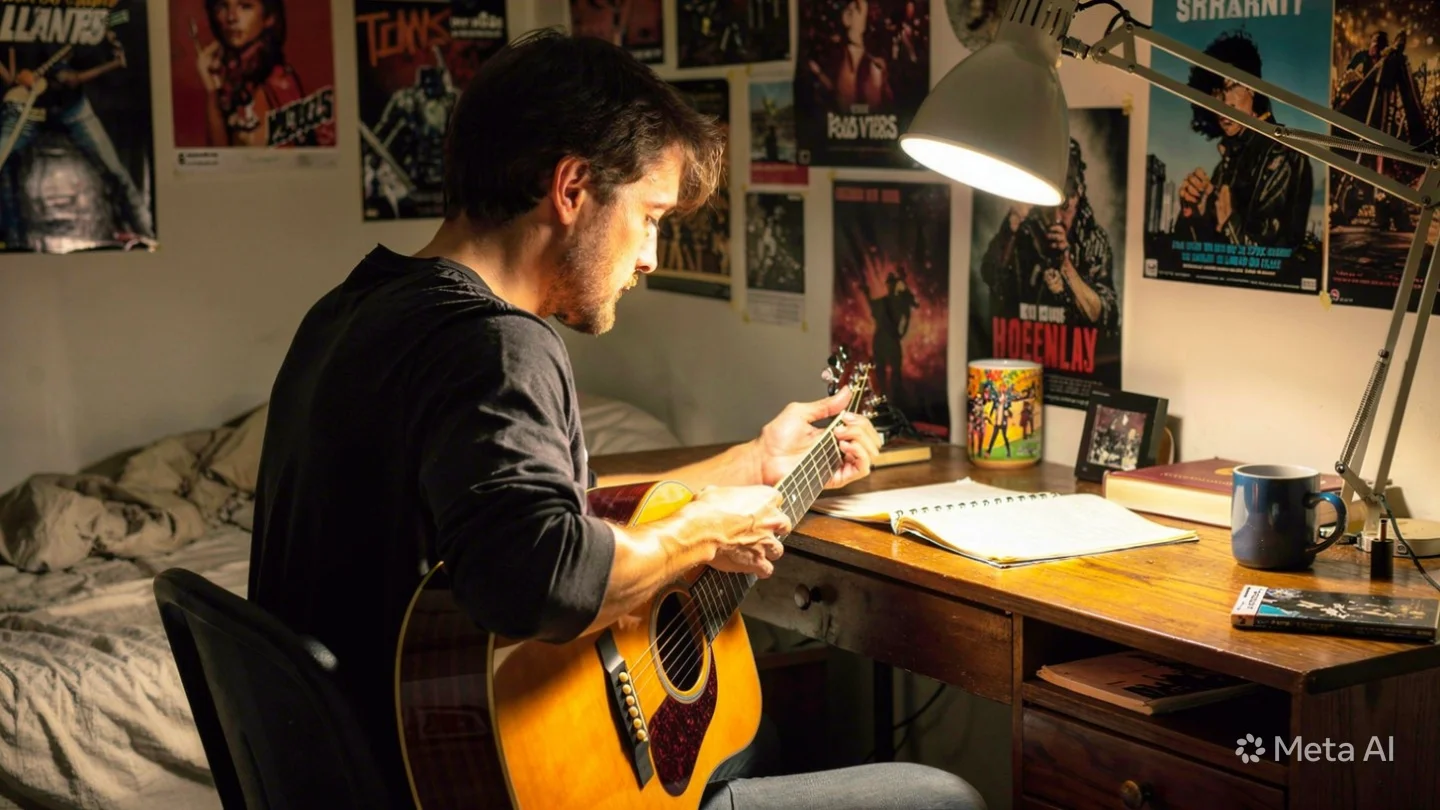
"A musician tuning a guitar, over-the-shoulder shot, warm tungsten light from a single lamp, calm and introspective mood, inside a small cluttered bedroom filled with posters."
The over-the-shoulder angle creates a sense of presence, as if the viewer is standing right behind the musician. The tungsten light adds warmth and authenticity. The environment is personal, almost intimate. It feels like a quiet moment before a performance.
10.

"A scientist examining a glowing vial, medium close-up, cold laboratory light with subtle reflections, tense and analytical mood, in a high-tech research facility."
This prompt works because it focuses on intention. The glowing vial becomes the emotional center of the scene. The lighting reinforces the sterile environment. The mood is tense, but not dramatic. It feels like a pivotal moment in a thriller or sci-fi narrative.
Why These Examples Matter
Each of these prompts uses the same five elements, but the results feel completely different. That's the beauty of the method. It doesn't limit your creativity. It gives you a framework that adapts to any genre, any emotion, any world you want to build.
More importantly, these examples show that cinematic prompts aren't about complexity. They're about clarity. They're about choosing the right details instead of all the details. They're about creating a moment that feels alive.
Once you start thinking this way, writing cinematic prompts becomes less about "finding the right words" and more about imagining the right moment.
Common Mistakes and How to Fix Them
Even with a solid method, it's easy to fall into habits that weaken a prompt. Most of these mistakes come from trying too hard or not trying enough. They're not dramatic errors, just small misalignments that pull the image away from the cinematic feeling you're aiming for. The good news is that each mistake has a simple fix, and once you recognize them, you'll start avoiding them almost instinctively.
Let's look at the ones that appear most often.
Mistake 1: Describing Everything Instead of Choosing Something
One of the fastest ways to flatten a cinematic moment is to overload the prompt with details. People often assume that more information means more control, but cinema doesn't work that way. A film frame is powerful because it focuses on what matters and lets the rest fade into the background.
When a prompt tries to describe every object, every color, every emotion, the model loses the thread. The image becomes busy instead of intentional.
How to fix it: Choose one strong idea and build around it. If the subject is a woman running, focus on her. If the moment is about tension, let the lighting and camera support that feeling. Clarity beats complexity every time.
Mistake 2: Forgetting the Camera
Many prompts describe what's happening but never describe how the viewer sees it. Without a camera angle or lens choice, the model defaults to a neutral, almost documentary-like perspective. The result is often technically correct but emotionally empty.
Cinema is defined by point of view. A low angle changes the meaning of a moment. A close-up changes the intimacy. A wide shot changes the scale.
How to fix it: Always include a camera choice, even a simple one. Eye-level medium shot. Wide 35mm shot. Close-up with shallow depth. These small decisions instantly add intention.
Mistake 3: Using Lighting as Decoration Instead of Emotion
Lighting is often treated as a stylistic accessory, something added at the end to make the image "look nice." But in cinema, lighting is emotional architecture. It shapes the mood long before the actors speak or the music begins.
When lighting is chosen randomly, the scene loses coherence. A tense moment with soft golden light feels contradictory. A peaceful scene with harsh shadows feels unintentionally dramatic.
How to fix it: Ask yourself what the moment should feel like, then choose the light that supports that feeling. Warm light for intimacy. Hard light for tension. Backlight for drama. Neon for stylization. Let the light carry emotion, not decoration.
Mistake 4: Mood That Doesn't Match the Scene
Mood is often added as an afterthought, a single word thrown into the prompt without much consideration. But mood is the emotional compass of the image. If it doesn't align with the subject, camera, and lighting, the scene feels confused.
A mysterious mood with a bright cheerful environment. A peaceful mood with a frantic action shot. A dramatic mood with flat lighting. These contradictions weaken the cinematic effect.
How to fix it: Choose a mood that naturally emerges from the other elements. If the lighting is soft and warm, the mood might be nostalgic or intimate. If the camera is low and the shadows are deep, the mood might be tense or dramatic. Let the mood be the glue that holds the scene together.
Mistake 5: Environments That Feel Generic
Many prompts end with environments that sound like placeholders: "in a city," "in a forest," "in a room." These descriptions are too broad to create atmosphere. They don't give the model enough to work with, so it fills the space with generic assumptions.
Cinema thrives on specificity. A forest at dawn feels different from a forest at night. A city street in the rain feels different from a city street at sunset.
How to fix it: Add one or two details that anchor the environment. A foggy nighttime street. A neon-lit alley. A quiet suburban neighborhood at dawn. A cluttered bedroom filled with posters. Small details create big worlds.
Mistake 6: Prompts That Read Like Lists Instead of Scenes
This is one of the most common issues. A prompt that reads like a list of descriptors feels mechanical. It lacks rhythm, intention, and flow. The model can still generate something decent, but it won't feel cinematic because cinema is about continuity, not accumulation.
How to fix it: Write the prompt as if you were describing a moment to someone standing next to you. Let the elements flow naturally. Start with the subject, then reveal the rest. Think in images, not in keywords.
Mistake 7: No Sense of Story
A cinematic image doesn't need a full narrative, but it needs a hint of one. A spark. A suggestion that something is happening or about to happen. Without that, the image feels static.
How to fix it: Add a small action or intention. Not a plot, just a gesture. Running. Waiting. Looking. Holding. These tiny verbs breathe life into the scene.
Mistake 8: Trying to Force a Style Instead of Letting It Emerge
Some prompts try to imitate a director or a genre by naming it directly. Sometimes it works, but often it feels artificial. Cinema isn't created by labels. It's created by choices.
How to fix it: Instead of saying "in the style of a noir film," use the elements that make noir feel like noir. Low angles. Harsh shadows. Rain-soaked streets. Reflective surfaces. Let the style emerge from the craft.
Mistake 9: Ignoring the Viewer's Perspective
A cinematic image always considers the viewer. It invites them into the moment. When a prompt ignores this, the image feels distant, like a stock photo.
How to fix it: Imagine you're behind the camera. Imagine you're choosing the angle. Imagine you're deciding what the viewer should feel. This mental shift changes everything.
Mistake 10: Forgetting That Simplicity Is a Strength
The most cinematic prompts are often the simplest. Not because they lack detail, but because they choose the right detail. They leave space for the model to interpret, for the moment to breathe.
How to fix it: Strip the prompt down to its essentials. If a word doesn't serve the moment, remove it. Let clarity guide you.
Conclusion
Cinematic prompts aren't about stacking keywords or chasing complexity. They're about choosing a moment and shaping it with intention. When you think like a director instead of a technician, the five elements fall naturally into place. The subject gives you something to care about, the camera decides how we enter the scene, the lighting sets the emotional temperature, the mood guides the viewer's feeling, and the environment gives the moment a world to exist in.
Once you start writing prompts this way, you stop describing images and start capturing scenes. You begin to sense the rhythm of a cinematic moment, the quiet balance between what you show and what you leave unsaid. And that's where the real magic happens. A single frame becomes a story, and a simple prompt becomes a doorway into a world that feels alive.
Ready to Create Your Own Cinematic Prompts?
Use our cinematic prompt builder to craft prompts using the five-step method: subject, camera, lighting, mood, and environment.
Try the ToolContinue Reading
- Modern Tarantino — Understanding Quentin Tarantino's Contemporary Visual Style
- Depth of Field — Understanding Every Form of Focus Control in Cinematic Imagery