INTRODUCTION
There's a moment in life when you realise something quietly true about yourself: you've always been creative, even if you never called yourself an artist. Maybe you imagined scenes while listening to music. Maybe you pictured characters while reading a book. Maybe you saw a landscape and instantly rewrote it in your mind with better light, better colours, better atmosphere.
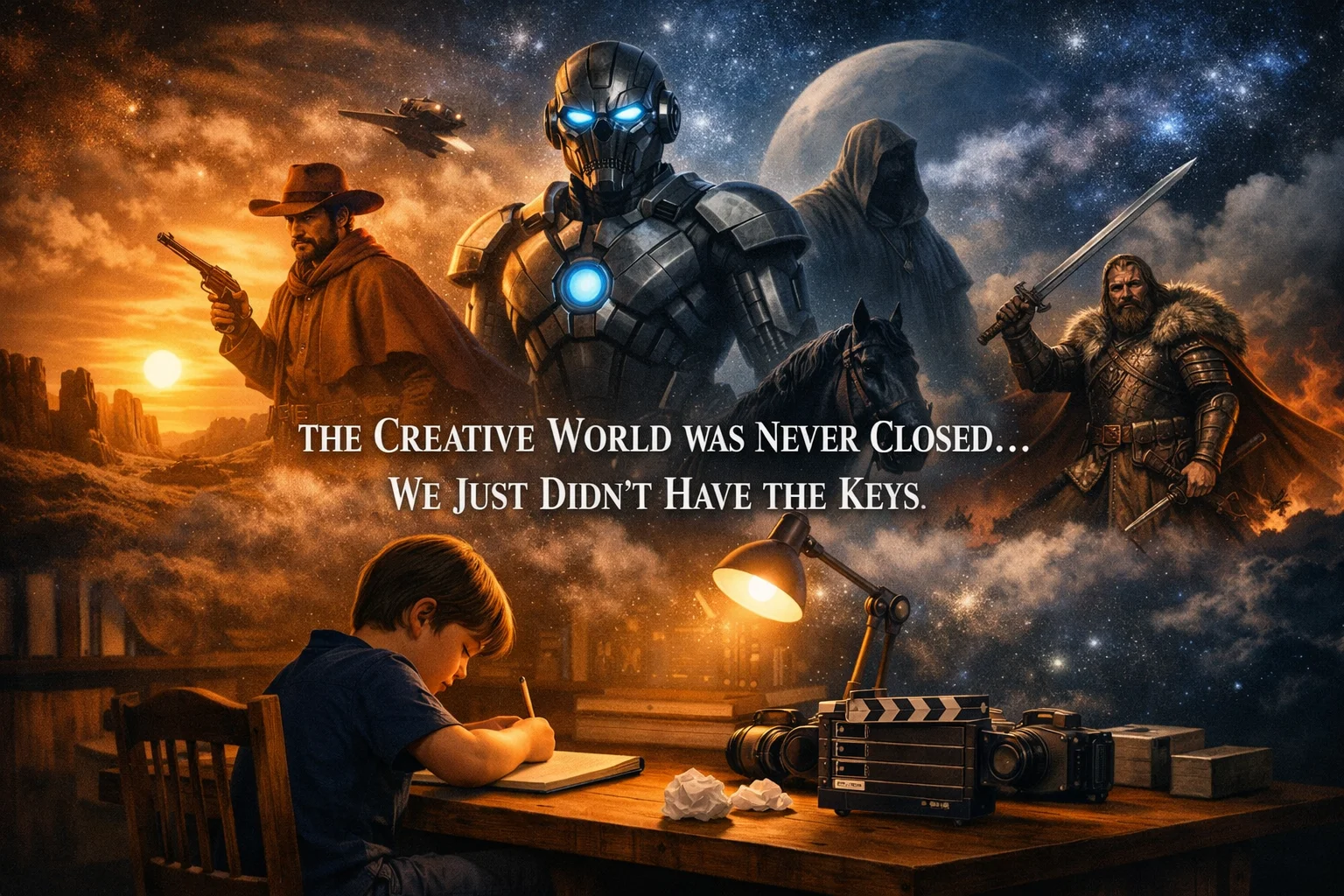
For many people, that creativity stayed internal. Not because imagination was missing, but because expressing it visually felt impossible. Drawing required talent. Photography required equipment. Design meant learning tools that looked intimidating. Most of us simply didn't have the means to turn our ideas into something we could show to others. So we kept everything in our heads, treating our imagination like a private space rather than something we could share.
Then AI arrived and something shifted. People who never saw themselves as artists suddenly had a way to transform ideas into images. Not through years of training or expensive gear, but through something much simpler: describing what they see in their minds.
This changed more than the creative process. It changed who gets to participate in it. AI didn't replace artists. It removed the barriers that kept most people from even trying. It gave space to a kind of creativity that always existed but never had the right tools.
If you're reading this, you've probably felt that shift too. Maybe you've already generated a few images. Maybe you're curious but unsure where to begin. Maybe you've always had ideas but never had a way to express them.
Wherever you are in that journey, one thing is true: your imagination deserves to be seen.
This article is about that. About how AI helps people who never considered themselves artists finally create, express and share what they've carried inside for years.
The Silent Creativity Most People Carry Inside
Most people grow up believing creativity belongs to a specific group of individuals. The ones who could draw well in school. The ones who played instruments. The ones who understood colour theory or composition or camera settings. Everyone else quietly stepped aside, assuming they didn't qualify.
But the truth is very different. Creativity has always been far more common than artistic skill. Almost everyone imagines things. Almost everyone visualises scenes, characters, moods or moments. Almost everyone has ideas that feel vivid inside their mind but impossible to express outside of it.
For years, this silent creativity lived in the background of everyday life. People imagined stories while commuting. They pictured alternate versions of places they visited. They saw faces in crowds and wondered who those people could be in a different world. They looked at sunsets and mentally adjusted the colours. They watched films and instinctively thought about how they would have framed a shot differently.
None of this required training. It was simply the natural way the mind plays with the world.
Yet most people never shared any of it. Not because they didn't want to, but because the gap between imagination and execution felt too wide. If you couldn't draw, you couldn't show the character you imagined. If you didn't know photography, you couldn't capture the atmosphere you felt. If you didn't understand editing software, you couldn't build the scene you saw in your head.
So the ideas stayed inside. Not forgotten, just unexpressed.
And this is something almost everyone can relate to. The quiet frustration of having a clear image in your mind and no way to bring it into reality. The feeling of being creative on the inside but invisible on the outside. The sense that you have something to say visually, but no language to say it with.
For a long time, creativity was limited by access. Access to tools, access to knowledge, access to time, access to opportunities. If you didn't have those things, your imagination remained private.
But that didn't make you less creative. It simply made you less equipped.
This is the part people rarely talk about. Creativity is not the ability to produce art. Creativity is the ability to imagine. And that ability has always been present in far more people than we ever acknowledged.
What changed recently is not the existence of creativity. What changed is the availability of tools that finally allow people to express it.
AI didn't create a new generation of creative people. It revealed the one that was already there.
When Imagination Finally Finds a Way Out
The first time you use an AI image tool, something unexpected happens. You realise how simple it is to turn a thought into something visible. Not a perfect image, not a masterpiece, but a starting point. A shape. A direction. Something you can react to.
For many people, this is the moment when creativity stops being theoretical and becomes practical. You no longer think about what you would create if you had the skills. You actually create something, even if it is small. Even if it is rough. Even if it is just a first attempt.
This shift is important because it changes your relationship with your own ideas. Instead of treating imagination as something abstract, you begin to treat it as something you can work with. You describe a scene, you see a result, and suddenly your idea is not just a thought anymore. It becomes something you can refine, adjust and explore.
AI becomes a tool that helps you take the first step. And for many people, that first step was always the hardest part.
What makes this experience powerful is not the technology itself. It is the feeling of progress. You write a few words, and you get something back. You try again, and it gets closer to what you had in mind. You experiment, and you start to understand what you like. You begin to see patterns in your own imagination.
It is a process that feels natural, even if you have never created anything before. You are not learning a complex skill. You are simply communicating with a tool that responds to your ideas. And because the barrier to entry is so low, you feel free to explore without pressure.
This is where many people realise something important. Creativity is not about producing perfect results. It is about expressing what you see, what you feel, what you imagine. AI gives you a way to do that without needing years of training or specialised knowledge.
It is not a shortcut. It is an opening.
An opening that allows your imagination to move from the inside to the outside. An opening that lets you experiment without fear. An opening that makes creativity feel accessible instead of intimidating.
For the first time, you are not limited by what you can physically do. You are guided by what you can imagine. And that changes everything.
Creativity Without Gatekeepers
For most of modern history, creativity came with gatekeepers. If you wanted to create images, you needed access to tools, training or communities that could guide you. If you wanted to work with visuals, you had to invest time, money or years of practice. Creativity was not just about imagination. It was about permission. Permission from skill, permission from resources, permission from circumstances.
AI changed that landscape in a way few people expected. It removed the idea that you need to qualify before you create. Suddenly, the door that once required credentials or talent became something anyone could walk through. You no longer need to prove yourself before expressing yourself.
This shift matters because it changes who gets to participate in visual creation. It is no longer limited to people who studied art or photography or design. It is no longer something reserved for those who had the right opportunities at the right time. Creativity becomes something you can access simply because you have ideas.
And ideas are universal.
This is why AI feels so empowering for so many people. It removes the pressure of being "good enough" before you start. You do not need to justify your creativity. You do not need to apologise for not having the skills. You do not need to wait for someone to validate your work. You can create because you want to, not because you earned the right to.
The absence of gatekeepers also changes the way people see themselves. Someone who never considered themselves creative suddenly realises they have a voice. Someone who thought they lacked talent discovers they have imagination. Someone who believed creativity belonged to others begins to understand that it belongs to everyone.
This is not about replacing artists. It is about expanding the definition of who gets to be one. It is about acknowledging that creativity was never exclusive. It was simply inaccessible.
AI does not make creativity effortless. It makes it available. And availability is what transforms a private idea into something you can share with the world.
When you remove the barriers, people step forward. They experiment. They explore. They express themselves. They discover that creativity is not a privilege. It is a human instinct that was waiting for the right moment to surface.
That moment is now.
The Two Types of People AI Helps (And Why Both Matter)
When people talk about AI and creativity, they often imagine a single type of user. Someone who has never created anything before and suddenly discovers a new world. That person exists, of course, but the reality is much broader. AI is not helping one group. It is helping two, and both are equally important in this new creative landscape.
The first group is made of people who always had imagination but never had the tools. They are the ones who pictured scenes in their minds but could not draw them. The ones who loved visual storytelling but never learned photography or design. The ones who felt creative on the inside but invisible on the outside. For them, AI is not a shortcut. It is a beginning. It is the first time they can express what they have carried for years.
The second group is made of people who already had skills. Artists, photographers, designers, filmmakers, illustrators. People who spent years learning their craft. People who know how to create but often lack the time, the resources or the workflow to explore every idea they have. For them, AI is not a replacement. It is an accelerator. It removes friction. It gives them space to experiment faster, to test concepts, to push their style in new directions.
These two groups might seem different, but they share something essential. Both have ideas. Both have imagination. Both want to express something. And AI gives each of them what they were missing.
For the first group, AI provides access. For the second group, AI provides speed.
And both forms of support matter.
This is why the conversation about AI and creativity should never be framed as "artists versus non-artists". That division was always artificial. Creativity does not belong to one side. It belongs to anyone who imagines. AI simply meets people where they are and gives them a way forward.
Some people finally get to create for the first time. Others get to create more freely than ever before.
Both experiences are valid. Both are powerful. Both deserve recognition.
What unites these groups is not skill level. It is the desire to bring imagination into the world. AI does not judge who is worthy of creating. It does not ask for credentials. It does not care about background. It responds to ideas, and ideas can come from anyone.
This is why AI feels transformative. It does not elevate one group above the other. It lifts both. It gives beginners the confidence to start and experienced creators the freedom to expand. It opens the door from both sides.
And when a tool can support such different people in such meaningful ways, it becomes more than technology. It becomes a catalyst. It becomes the thing that finally allows creativity to be shared instead of hidden.
The Joy of Creating Without Fear of Failure
One of the most surprising things about creating with AI is how quickly the pressure disappears. In traditional art, the fear of making a mistake often stops people before they even begin. You worry about ruining a drawing, wasting time, or producing something that looks nothing like what you imagined. That fear is strong enough to silence creativity for years.
AI changes that dynamic completely. When you generate an image, there is no sense of risk. You are not ruining anything. You are not wasting materials. You are not judged by a blank canvas that expects perfection. You are simply trying something, seeing what happens and deciding what to do next.
This freedom is powerful because it removes the emotional weight that usually comes with creative attempts. You do not need to get it right on the first try. You do not even need to know what "right" looks like. You can explore without consequences. You can experiment without hesitation. You can follow your curiosity instead of your doubts.
And when the fear disappears, something interesting happens. You start to enjoy the process. You begin to play with ideas the same way you did as a child, when creativity was natural and effortless. You try different moods, different scenes, different characters, not because you are chasing perfection but because you want to see where your imagination can go.
This sense of play is often missing in adult life. Responsibilities, routines and expectations tend to push creativity aside. AI brings it back in a way that feels accessible and refreshing. It gives you a space where you can create without pressure, without deadlines and without the feeling that you need to justify your attempts.
The joy comes from the simplicity of it. You imagine something, you describe it and you see a result. If you like it, you continue. If you don't, you try again. There is no failure in this process. Every attempt teaches you something about your own taste. Every variation shows you a new possibility. Every image becomes a small step forward.
This is why so many people find themselves creating more than they expected. Not because they suddenly became more talented, but because the fear that once held them back is no longer there. Creativity becomes something you do for yourself, not something you perform for others.
And when you remove the fear of failure, you make space for something far more important: enjoyment. The simple, genuine enjoyment of bringing ideas to life.
Why Sharing Your Imagination Matters
Creating something with AI is powerful, but sharing it adds another layer of meaning. When you show your images to others, you are not just posting a picture. You are revealing a part of how you see the world. You are giving shape to something that used to exist only in your mind. And that act, simple as it seems, has value.
People often underestimate how personal imagination is. The way you picture a scene, the colours you choose, the mood you gravitate toward, the characters you invent. All of this reflects something about you. Not in a dramatic or symbolic way, but in a natural, human way. It is your taste, your curiosity, your perspective. When you share an image, you are sharing a viewpoint that only you could have created.
This is why sharing matters. It turns creativity into connection. Someone sees your image and feels something. Maybe they recognise a feeling they've had before. Maybe they discover a style they never considered. Maybe your idea sparks one of their own. Creativity becomes a conversation instead of a private thought.
AI makes this possible for people who never had the chance to participate in visual culture. Before, sharing required skill or equipment. Now it requires imagination and willingness. That shift opens the door to voices that were never heard before. People who thought they had nothing to contribute suddenly realise they do. They realise their imagination has a place in the world.
Sharing also changes the way you see your own ideas. When you keep everything to yourself, it is easy to dismiss your creativity as unimportant. But when you share something and someone reacts to it, even in a small way, you understand that your imagination has impact. It resonates. It reaches someone. And that feeling encourages you to keep creating.
There is also a simple truth: creativity grows when it is expressed. The more you share, the more confident you become. The more confident you become, the more you explore. The more you explore, the more your imagination expands. It becomes a cycle that feeds itself, and sharing is the spark that keeps it alive.
AI gives you the ability to create, but sharing gives your creations purpose. It turns imagination into something that travels beyond your own mind. It allows your ideas to exist in the world, not just inside you. And that is a powerful shift for anyone who spent years believing their creativity had no outlet.
Sharing is not about seeking approval. It is about participating. It is about taking part in a creative world that is finally open to everyone. It is about letting your imagination breathe outside of your thoughts and into a space where others can experience it too.
Your images do not need to be perfect. They do not need to follow trends. They do not need to impress anyone. They simply need to exist. Because when they exist, they become part of a larger creative landscape that is richer because you contributed to it.
How AI Helps You Discover Your Own Style (Even If You Never Had One)
One of the most surprising things about creating with AI is how naturally your personal style begins to emerge. Even if you never thought you had one, even if you never created anything before, patterns start to appear in the images you generate. Not because you are trying to develop a style, but because your imagination already had preferences long before you realised it.
At first, you experiment without thinking too much. You try different moods, different scenes, different characters. You follow whatever idea comes to mind. But after a while, you notice something. Certain colours appear more often. Certain atmospheres feel more natural to you. Certain compositions feel closer to what you enjoy. You start to recognise yourself in the images you create.
This is how style begins. Not through rules or theory, but through instinct. AI simply makes it visible.
For people who never created art before, this can be a surprising discovery. Many assume that style is something only trained artists develop. Something that requires years of practice or deep knowledge. But style is not a technical achievement. It is a reflection of taste. And taste is something everyone has.
AI gives you the space to explore that taste without pressure. You can try a dramatic scene one moment and a calm one the next. You can switch from fantasy to realism, from portraits to landscapes, from bright colours to muted tones. Each attempt teaches you something about what feels right to you.
Over time, you begin to understand what draws you in. Maybe you prefer soft light. Maybe you gravitate toward cinematic shadows. Maybe you enjoy surreal elements or grounded realism. Whatever it is, AI helps you see it clearly because it gives you instant feedback. You imagine something, you generate it, and you learn from the result.
This process is valuable because it builds a sense of identity. You are not just creating random images. You are shaping a visual language that belongs to you. You begin to recognise your own fingerprints in your work, even if you never set out to create a signature style.
And this discovery often leads to something deeper. You start to trust your instincts. You stop worrying about whether your ideas are "good enough" and start focusing on what feels authentic. You realise that creativity is not about matching someone else's standards. It is about expressing what resonates with you.
AI does not give you a style. It reveals the one you already had. It shows you that your imagination has direction, preference and personality. It helps you understand yourself creatively in a way that might have taken years through traditional methods.
And once you see your style taking shape, you begin to create with more intention. Not because you feel obligated, but because you finally recognise the creative identity that was always there.
A Personal Reflection: What AI Taught Me About Creativity
When I look back at my life, I realise creativity was always there, even if it changed shape over the years. As a child, it started with writing. I used to create little stories and read them to my classmates in primary school. My teacher encouraged me, and that encouragement mattered more than I understood at the time. Recognition has a strange power. It makes you believe your ideas are worth something.
Later, in secondary school, the tone changed. The focus shifted to grammar, punctuation and structure. Nothing wrong with that, of course, but it made creativity feel like something that needed permission. My imagination was still there, but the environment wasn't built for it. I learned early that creativity can be fragile when the world around you doesn't know how to hold it.
Then came video editing. That was the first time I felt a real sense of creative freedom again. I loved football, so I started making videos about my favourite team and players. I spent hours choosing music, cutting clips, building transitions and shaping the rhythm of each scene. When people commented on YouTube, when they said they enjoyed what I made, it felt like that moment in primary school all over again. Recognition didn't inflate my ego. It simply kept the fire alive.
But the landscape changed. Copyright rules tightened, monetisation took over, and suddenly the platform that once felt open became restrictive. I couldn't use the clips I wanted. I couldn't use the music that inspired me. I couldn't share the videos I spent hours creating. The joy faded. And with adult life, responsibilities and lack of time, I slowly stepped away from something I loved.
Still, the urge to create never disappeared. It showed up in different places. In video games, I spent hours in character creation modes, adjusting faces, outfits, proportions. In WWE games, I even used Photoshop to make face maps and import them into the game. It was a small thing, but it scratched the same itch: the desire to shape something that didn't exist before.
Later, I bought a 3D printer. I printed models from online communities, learned a bit of Fusion, tried to design my own objects. But again, time, noise, space and complexity made it difficult to go deeper. Creativity was always present, but life kept placing obstacles between me and the things I wanted to make.
What AI taught me is that creativity today is easier to access than ever. Everything is within reach of a screen. I can be creative without needing long hours, without needing expensive tools, without needing to fight against the limits that once held me back. The beauty of generative AI is exactly this: anyone can express something quickly, visually and with a sense of freedom that didn't exist before.
It allows you to show what you imagine in a matter of seconds. It lets you share ideas in a visual form instead of keeping them in your head. And sometimes it is not even about creating something serious. Sometimes it is just about having fun, making a caricature of a friend, sending it to them and laughing together. Creativity becomes light again. Playful again. Accessible again.
But I wanted more than the basics. I wanted to understand how to speak the language of generative AI in a more cinematic way. I wanted to learn how to communicate with it using lenses, lighting, shot types, actions, aspect ratios and all the little details that shape a scene. And that's when the first challenge appeared: how was I supposed to remember all these new parameters?
That question became the seed of an idea. If I couldn't memorise everything, maybe I could build something that helped me. Something simple. Something visual. Something that allowed me to click, choose and organise my thoughts without having to store everything in my head.
So I created a small tool for myself. Nothing ambitious. Just a way to keep track of the parameters I was learning and use them more easily. But as soon as it existed, another thought followed naturally: why not share it? Why not let others benefit from something that was helping me so much?
And that is how this website was born. Not from a business plan. Not from a strategy. But from the same instinct that has followed me since childhood: the need to create something.
In a way, the existence of this site is proof of who I've always been. Someone who imagines, someone who builds, someone who tries to give shape to ideas. AI didn't create that part of me. It simply gave it space to grow again.
Ready to Start Creating?
Use our cinematic prompt builder to turn your imagination into stunning AI-generated images.
Try the ToolContinue Reading
- How to Create Cinematic Prompts • The complete guide (2026 Edition)
- How to Write Prompts That Look Like Movie Scenes • The five-step method for cinematic AI imagery