

Table of Contents
- 1. Introduction
- 2. Understanding the Peaky Blinders Cinematic Identity
- 3. The Color Language of Peaky Blinders
- 4. Light, Shadow, and Atmosphere
- 5. Costume and Texture: The Peaky Blinders Look
- 6. Industrial Birmingham as a Character
- 7. Character Driven Prompt Variations (Without Using Real Characters)
- 8. Final Prompt Blueprints for Peaky Blinders Cinematics
- 9. Conclusion
Introduction
Peaky Blinders began as a grounded period drama about a working class gang in post war Birmingham, but it quickly grew into something far more distinctive. The series built its identity on atmosphere, character psychology, and a visual style that felt unusually deliberate for television at the time. Every season sharpened that identity, turning the show into a reference point for anyone interested in cinematic storytelling.
The foundation of the series comes from Steven Knight, who created and wrote the majority of the episodes. Knight grew up hearing stories about real Birmingham gangs, and that personal connection shaped the tone of the show. His writing gave the narrative its mix of ambition, violence, and moral conflict, and it set the emotional rhythm that defines the Shelby family.
The visual side of Peaky Blinders was shaped by a rotating group of directors who approached the material with a filmmaker’s mindset. Otto Bathurst established the early look: industrial, smoky, and heavy with tension. Colm McCarthy refined the pacing and atmosphere. Anthony Byrne, who directed several later seasons, pushed the style into its most polished form, emphasizing controlled lighting, slow burn tension, and a sense of ritual in the way scenes unfold.
Behind them was a creative team that understood how to turn a historical setting into a visual signature. Cinematographers like George Steel built the show’s contrast between cold daylight and warm interiors. Production designers shaped Birmingham into a world of furnaces, factories, and narrow streets. Costume designers elevated the Shelby wardrobe into a cultural symbol, using texture and tailoring to express power, class, and identity.
Before diving into prompts, it’s important to understand how these elements work together. The style of Peaky Blinders isn’t defined by a single prop or color palette — it’s the combination of mood, geography, class tension, and the weight carried by every character. Once you understand the creative forces behind the series, you can begin to translate that identity into AI prompts that feel authentic and cinematic.
Understanding the Peaky Blinders Cinematic Identity
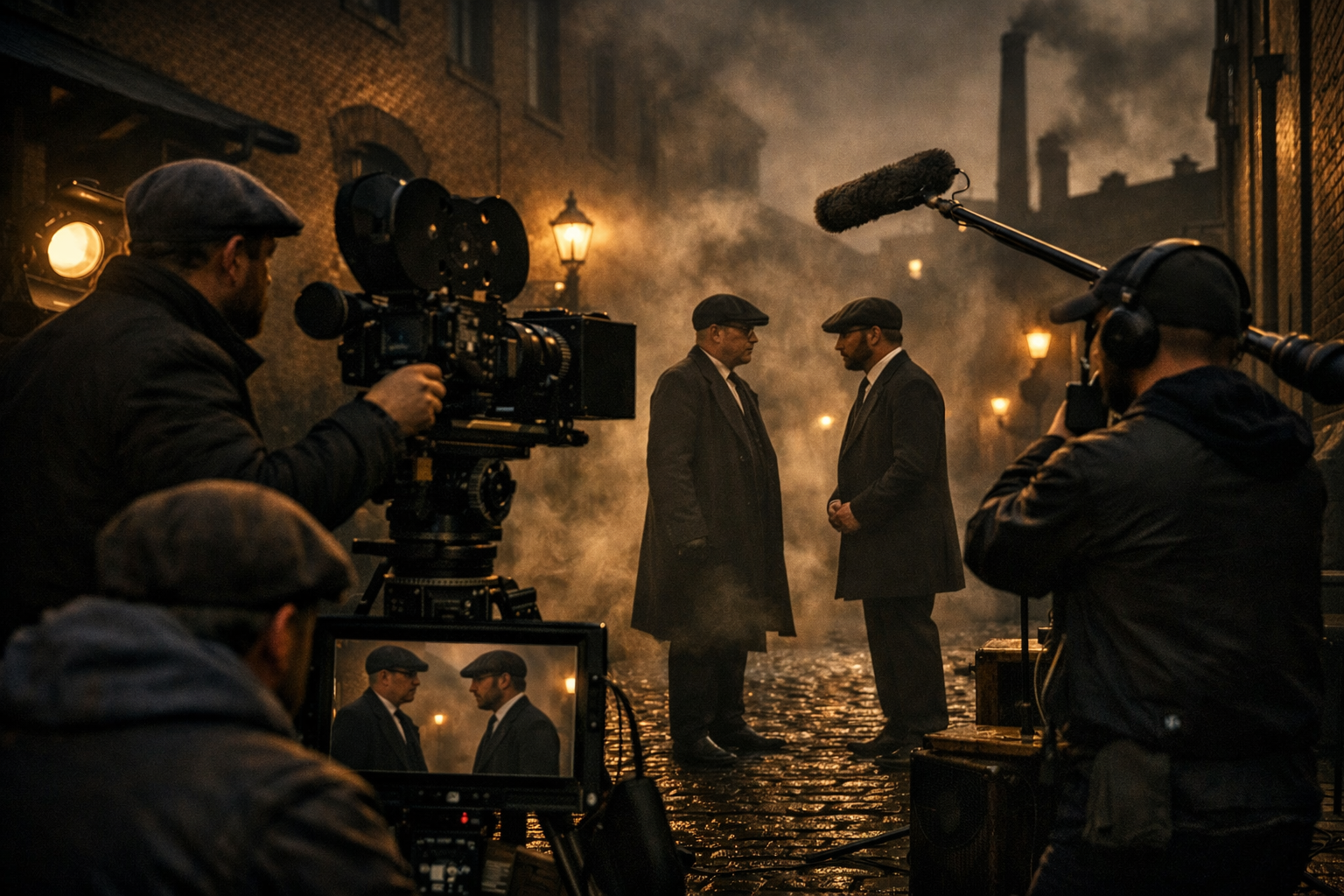
The visual identity of Peaky Blinders is built on a combination of mood, geography, and character psychology. It’s a style shaped by industrial landscapes, controlled lighting, and a constant tension between elegance and violence. Understanding this foundation is essential before attempting to recreate the look in AI.
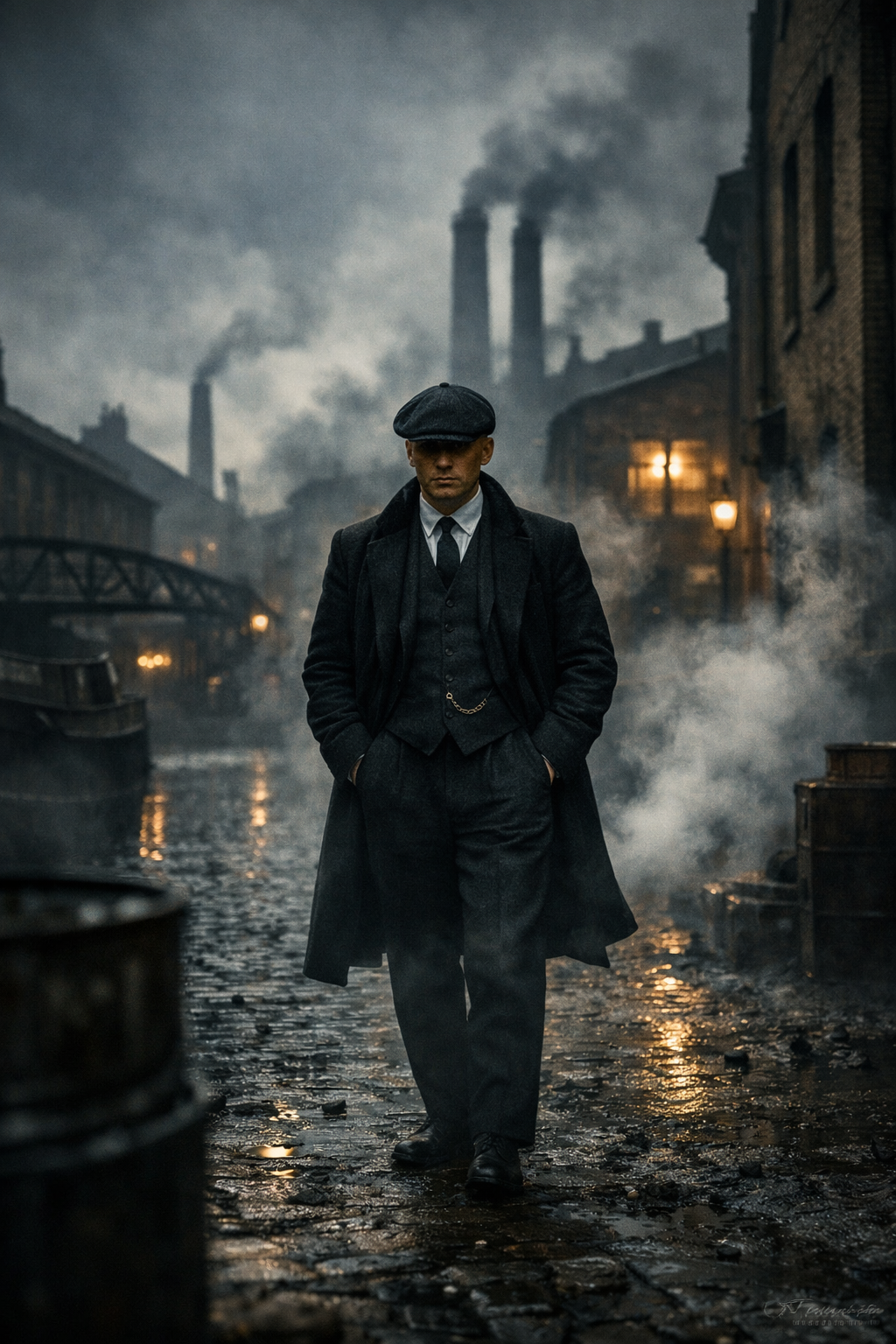
At its core, the series blends industrial realism with cinematic stylization. Birmingham is not just a backdrop; it’s a world of factories, furnaces, canals, and soot covered streets that define the tone of every scene. The environment carries weight, and the characters move through it with a sense of purpose shaped by class struggle and ambition.
The show’s identity also comes from its controlled color palette. Desaturated blues, muddy browns, and warm interior highlights create a contrast that feels both historical and modern. This palette reinforces the emotional landscape of the story: cold exteriors, tense negotiations, and interiors lit by firelight or dim lamps.
Lighting is another defining element. The series relies heavily on low key lighting, silhouettes, and smoke filled rooms. Shadows are used to shape faces, hide intentions, and build tension. Scenes often feel heavy, as if the air itself carries the weight of the characters’ decisions.
Texture plays a major role as well. Tweed, wool, leather, metal, mud, and smoke all contribute to the tactile quality of the world. These materials aren’t decorative; they express class, power, and identity. The Shelby look is sharp and deliberate, standing in contrast to the roughness of the environment around them.
Finally, the show’s cinematic identity is defined by its psychological framing. Close ups linger on eyes, hands, and subtle expressions. Wide shots emphasize isolation or dominance. Slow motion sequences highlight ritual and control. Every frame is designed to communicate something about hierarchy, danger, or internal conflict.
When you combine industrial landscapes, controlled lighting, desaturated color, tactile textures, and psychological framing, you get a visual identity that is unmistakably Peaky Blinders. This is the foundation you need before crafting prompts that feel authentic to the series.
The Color Language of Peaky Blinders
The color palette of Peaky Blinders is one of the strongest anchors of its visual identity. It’s a controlled, deliberate system built around desaturation, contrast, and the emotional weight of the setting. Understanding this palette is essential if you want your prompts to feel grounded in the world of the Shelbys.
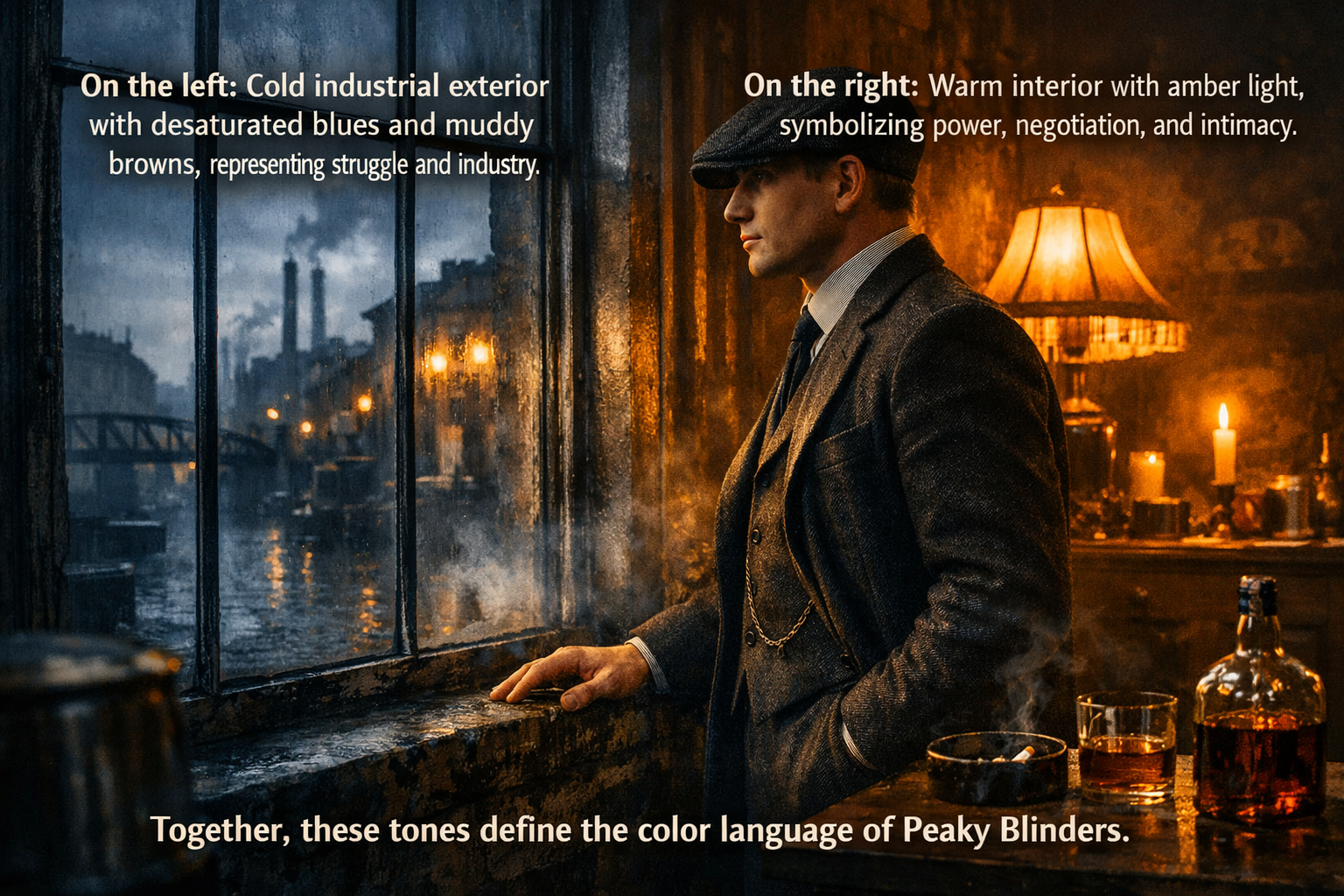
The foundation of the palette is a mix of cold desaturated blues and muddy industrial browns. These tones dominate exterior scenes, especially in the factories, canals, and streets of Birmingham. They communicate a world shaped by soot, metal, and economic struggle. Nothing feels clean or polished; the colors carry the residue of industry.
Interiors shift toward warm highlights — firelight, lamps, and amber reflections. This warmth isn’t cozy; it’s strategic. It creates contrast against the cold exteriors and adds tension to conversations, negotiations, and confrontations. The warmth often sits low in the frame, coming from candles or lamps, while the rest of the room remains in shadow. This creates a layered, atmospheric look that feels both intimate and dangerous.
Another key element is the controlled saturation. The show rarely uses strong colors. Even when a scene includes red fabric, green glass, or blue uniforms, the saturation is pulled back. This restraint keeps the world cohesive and prevents any single element from breaking the mood. It also reinforces the historical setting without relying on sepia or vintage filters.
Costume colors follow the same logic. The Shelby suits use charcoal, navy, and muted tones that blend into the environment. Workers’ clothing leans toward earth colors and worn fabrics. Aristocratic characters introduce slightly richer tones, but even those remain controlled. The palette always reflects class, power, and the emotional temperature of the scene.
Finally, the show uses color contrast to guide attention. A warm face against a cold background. A dark silhouette against a pale sky. A glowing cigarette in a dim room. These contrasts are subtle but intentional, and they help define the show’s cinematic rhythm.
When you combine desaturated blues, industrial browns, warm highlights, controlled saturation, and strategic contrast, you get the color language that makes Peaky Blinders instantly recognizable. This palette is the backbone of any prompt that aims to recreate the show’s atmosphere.
Light, Shadow, and Atmosphere
The lighting style of Peaky Blinders is one of the most defining elements of its visual identity. It’s a world built on low key setups, directional light, and a constant interplay between smoke, shadow, and texture. If you want your prompts to feel authentic to the series, you need to understand how these elements work together.
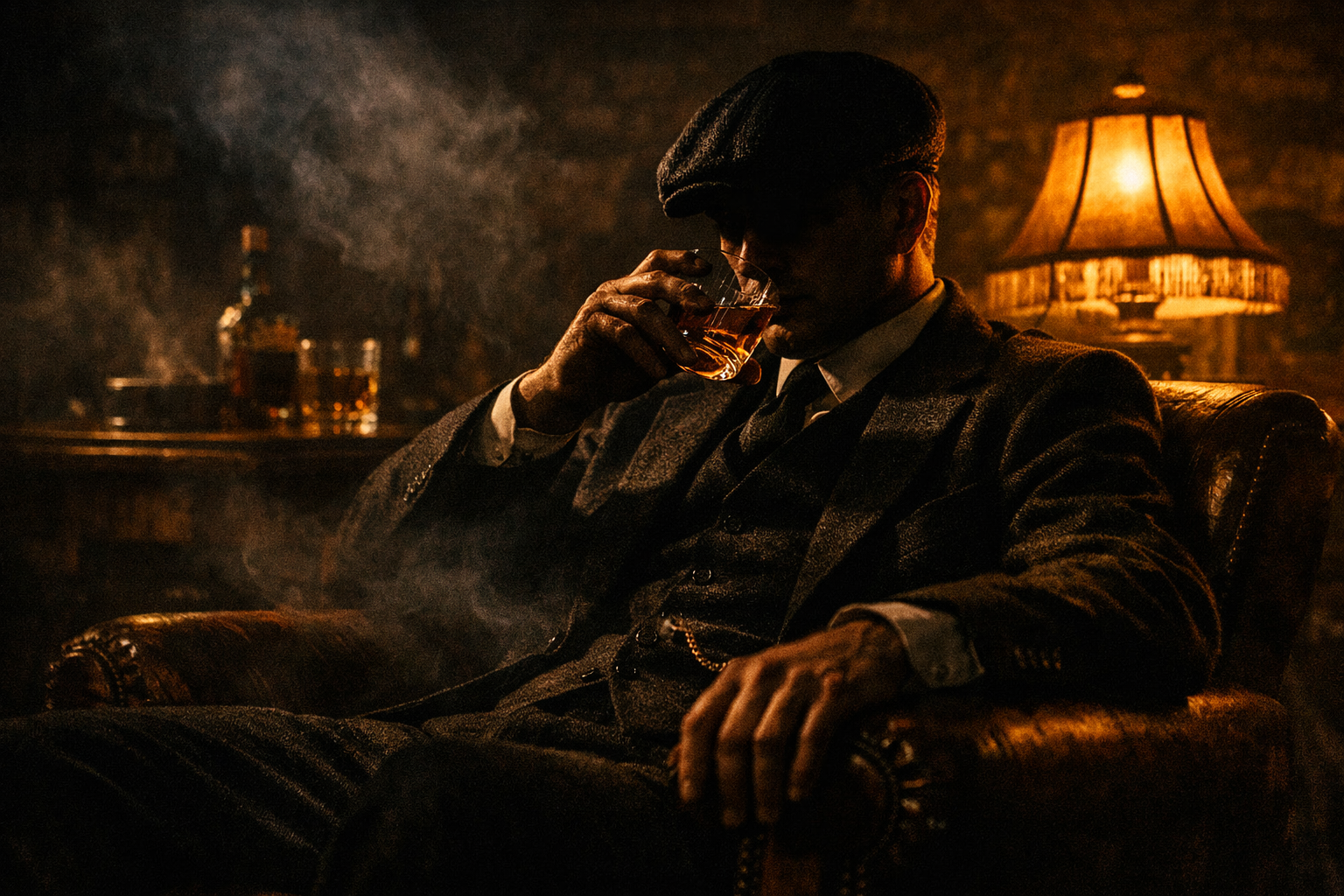
The foundation is low key lighting. Most scenes rely on minimal light sources, often placed at sharp angles. This creates deep shadows, strong silhouettes, and a sense of tension that sits beneath every conversation. Faces are partially obscured, revealing just enough to show intent while keeping emotion controlled.
Another essential element is the use of motivated light — light that appears to come from a natural source inside the scene. Lamps, windows, furnaces, and candles shape the direction and intensity of the light. This keeps the world grounded while still allowing for dramatic contrast. The result is a look that feels authentic to the period but still cinematic.
Atmosphere is equally important. The show uses smoke and haze to soften edges, deepen shadows, and add weight to the air. Smoke isn’t just a stylistic choice; it’s part of the environment. Factories, pubs, and backrooms all feel dense and lived in. This haze catches the light and creates the glowing edges that have become a signature of the series.
The contrast between cold daylight and warm interior light is another defining feature. Exterior scenes often use pale, desaturated daylight that emphasizes the industrial harshness of Birmingham. Interiors shift to amber tones from lamps and firelight, creating a visual divide between public tension and private strategy.
Shadows are used with intention. They hide faces, isolate characters, and create psychological distance. A character stepping out of shadow often signals a shift in power or intent. The show treats darkness as a narrative tool, not just a visual one.
Finally, the atmosphere is shaped by controlled contrast. Highlights are never overly bright, and shadows never collapse into pure black. This balance keeps the image rich and textured, allowing details in clothing, smoke, and architecture to remain visible even in low light.
When you combine low key lighting, motivated sources, atmospheric haze, cold exteriors, warm interiors, and controlled contrast, you get the atmospheric backbone of Peaky Blinders. This is the lighting language your prompts need if you want to recreate the show’s tension and cinematic weight.
Costume and Texture: The Peaky Blinders Look
The costume design of Peaky Blinders is one of the clearest expressions of the show’s identity. It’s not just about the sharp tailoring of the Shelbys; it’s a full visual system built on texture, class, and the industrial world the characters move through. Understanding this range is essential if you want your prompts to capture the full texture of the series.
The Core Peaky Blinders Wardrobe
At the center of the aesthetic is the working class gangster look. The signature elements are flat caps, heavy wool coats, tailored three piece suits, pocket watches, and leather gloves. These pieces aren’t decorative — they signal discipline, hierarchy, and a sense of ritual. The fabrics are thick and textured: tweed, wool, herringbone, and brushed cotton. These materials catch low key light in a way that reinforces the show’s gritty atmosphere.
The Broader Peaky Blinders World
The Peaky Blinders universe extends far beyond the Shelby wardrobe. Industrial workers wear earth tone layers: worn jackets, soot stained shirts, suspenders, and caps softened by years of labor. Their clothing blends into factories, furnaces, and muddy streets, creating a visual continuity between character and setting.
Rival gangs introduce variations. Italian, Jewish, and Irish groups bring different cuts, fabrics, and silhouettes, but always within the same muted palette. Their style reflects identity and territory, not fashion. The differences are subtle: a sharper lapel, a darker coat, a cleaner shirt — enough to signal factional tension without breaking the world.
The upper classes add another layer. Aristocrats, politicians, and business owners wear richer fabrics — velvet, fine wool, polished leather — but even these remain controlled in color. Their clothing is structured and pristine, intentionally contrasted with the industrial world around them. This contrast is part of the show’s visual storytelling: power expressed through texture and restraint.
Women’s costumes follow the same logic. Flapper dresses, long coats, silk blouses, and tailored skirts appear in muted tones that match the world rather than disrupt it. Satin and lace are present, but never overly bright or modern. Their textures add softness without breaking the palette.
Accessories complete the identity. Razors sewn into caps, pocket watches, cigarette cases, polished boots, and wool gloves all contribute to the tactile realism of the world. These details matter in prompts because they anchor the image in the period and the culture of the gang.
How to Describe Clothing in Prompts
To recreate the Peaky Blinders look, focus on texture, weight, fit, and period accuracy.
Useful vocabulary:
• fabric weight — heavy wool, thick tweed, coarse cotton, brushed wool
• texture — herringbone, pinstripe, worn leather, matte metal
• fit — tailored, structured, slim cut, high waisted trousers
• condition — weathered, soot stained, creased, polished
• period details — flat cap, detachable collar, waistcoat buttons, pocket watch chain
• color language — charcoal grey, muted navy, industrial brown, desaturated black
These terms anchor the prompt in the world of the Blinders.
Prompt Structures for Clothing:
1. Character focused clothing prompt
“A 1920s working class gangster wearing a tailored charcoal three piece suit, heavy wool overcoat, flat cap in muted herringbone, leather gloves, polished dark boots, pocket watch chain visible, textures catching low key cinematic light.”
2. Industrial worker prompt
“A 1920s Birmingham factory worker in earth tone layers, soot stained shirt, worn suspenders, thick wool cap, weathered jacket, muddy boots, clothing blending into industrial smoke and cold daylight.”
3. Upper class contrast prompt
“A 1920s aristocrat in fine wool coat, velvet lapels, polished leather shoes, muted burgundy waistcoat, structured silhouette, standing in warm interior light against a cold industrial background.”
4. Group shot prompt
“A group of 1920s Peaky Blinders gang members wearing heavy wool coats, tailored suits, flat caps, leather gloves, muted tones, rough textures, smoke drifting through low key lighting.”
Full Prompt Examples (Ready to Use)
Example 1 — Classic Peaky Blinder
“Cinematic portrait of a 1920s Peaky Blinder wearing a charcoal three piece suit, heavy wool overcoat, flat cap with herringbone texture, leather gloves, pocket watch chain, matte textures illuminated by warm interior light and surrounding smoke.”
Example 2 — Street Scene
“1920s Birmingham street scene with Peaky Blinders in dark wool coats, tailored suits, flat caps, polished boots, muted palette, industrial haze, cold daylight, soot covered brick walls.”
Example 3 — Industrial Worker Contrast
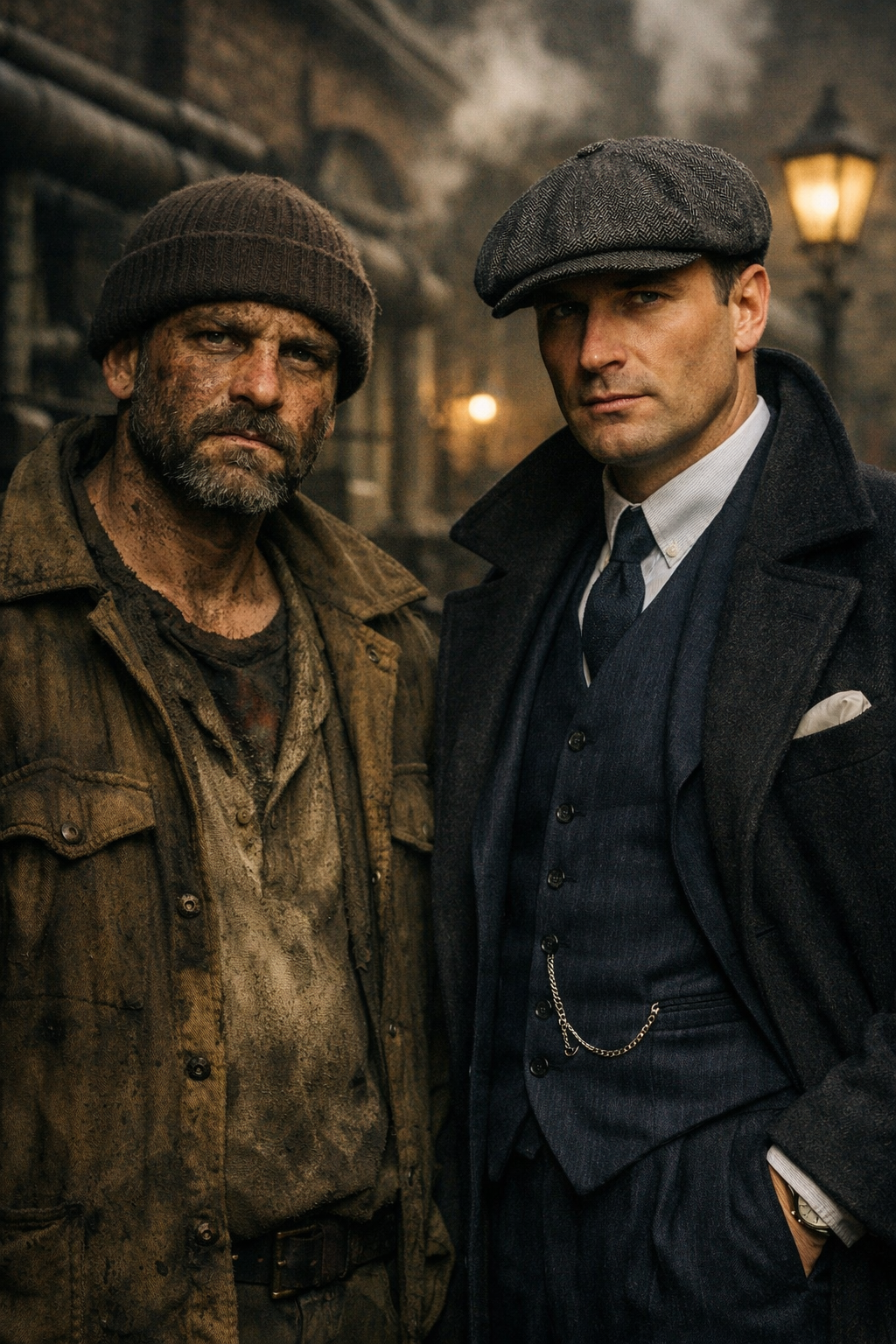
“Close up of a factory worker in worn earth tone clothing, soot stained shirt, thick wool cap, weathered jacket, standing beside a sharply dressed gangster in a tailored navy suit and heavy overcoat, both lit by low key industrial light.”
Industrial Birmingham as a Character
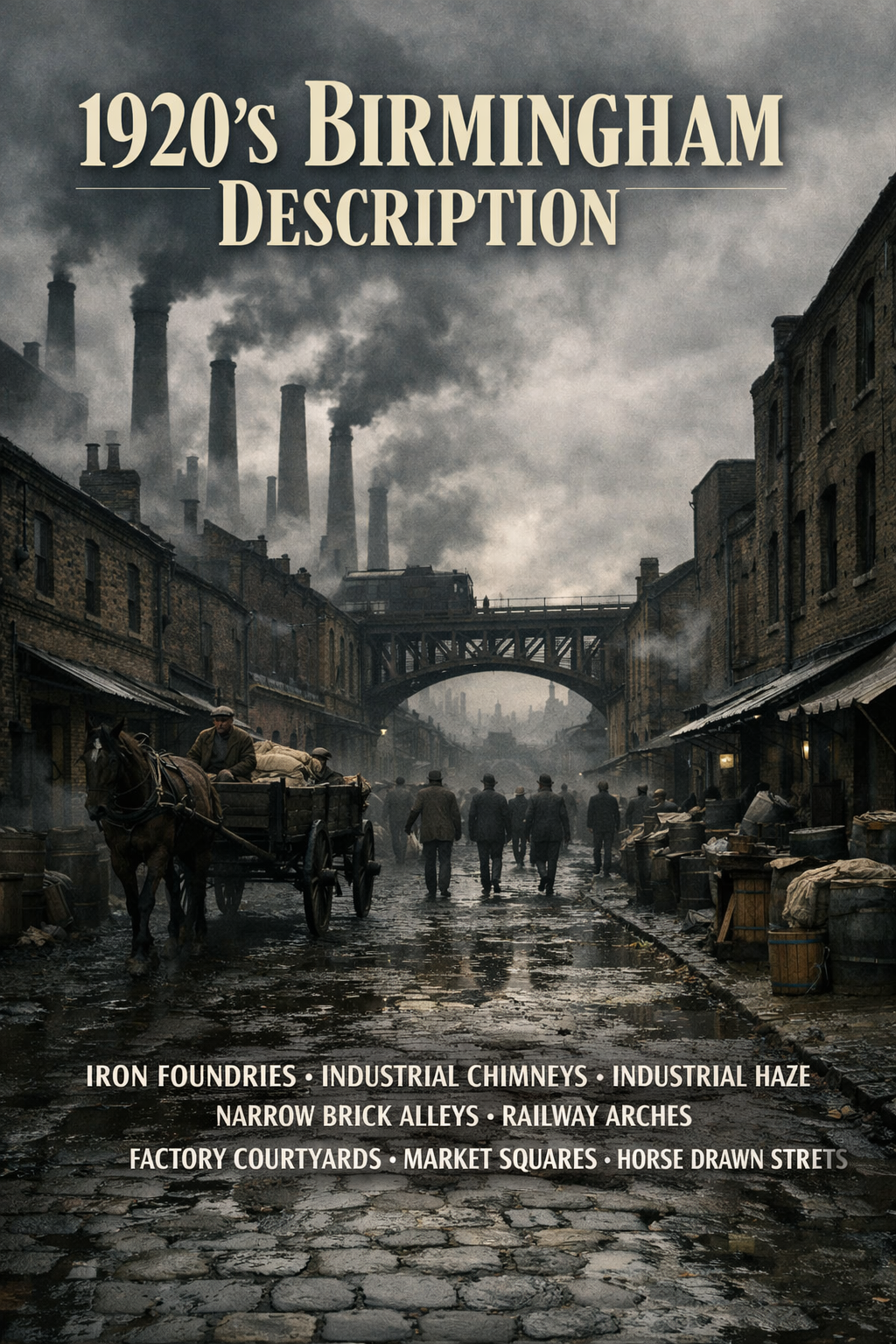
The world of Peaky Blinders doesn’t treat Birmingham as a backdrop. It treats it as a living force — a presence that shapes the characters, the mood, and the visual identity of the series. The industrial landscape defines the tone of every scene, and understanding this environment is essential if you want your prompts to feel grounded in the world of the Blinders.
Birmingham is built on industrial geography: factories, furnaces, canals, rail lines, brick alleys, and soot covered streets. These locations aren’t chosen for decoration. They express the economic pressure, class struggle, and constant tension that drive the story. The environment is harsh, cold, and heavy — a world where ambition is forged in smoke and metal.
The show’s visual language relies on industrial textures. Brick walls stained by decades of soot. Iron beams rusted by rain. Muddy cobblestones reflecting cold daylight. Thick smoke drifting from chimneys and furnaces. These textures create a tactile realism that defines the atmosphere of the series. They also interact with the lighting style: smoke catches the glow of lamps, wet streets reflect silhouettes, and brick absorbs shadows.
Another defining element is the canal system. The canals introduce stillness, reflection, and danger. They are places of negotiation, betrayal, and quiet violence. The water is dark and opaque, mirroring the moral ambiguity of the world. Scenes near the canals often use cold daylight, fog, and long shadows to emphasize isolation.
Factories and foundries shape the rhythm of the environment. Their interiors are lit by furnace glow, creating warm highlights against cold metal. Sparks, steam, and machinery add movement and texture. These spaces feel alive not because of people, but because of the constant mechanical pulse of industry.
The streets of Birmingham carry their own identity. Narrow alleys, wet cobblestones, horse drawn carts, and gas lamps create a sense of confinement and tension. The world feels dense and layered, with smoke drifting through every frame. This density is essential when building prompts that aim to recreate the show’s atmosphere.
Even interiors reflect the industrial world. Offices, pubs, and backrooms use dark wood, iron fixtures, and low ceilings. Warm interior light contrasts with the cold exterior, reinforcing the divide between public danger and private strategy.
When you combine industrial geography, heavy textures, cold daylight, furnace glow, and smoke filled air, Birmingham becomes more than a location, it becomes a character. It shapes the mood, the stakes, and the visual identity of Peaky Blinders. Any prompt that aims to recreate the world of the Blinders needs to treat the environment with the same weight as the characters themselves.
Technical Vocabulary for Describing Industrial Birmingham
| Industrial Structures | Textures & Materials | Atmospheric Elements | Urban Geography | Interior Spaces |
|---|---|---|---|---|
| brick factories | soot stained brick | industrial haze | narrow brick alleys | smoke filled pubs |
| iron foundries | wet cobblestone | cold daylight | canal towpaths | backroom offices |
| steel mills | rusted iron beams | furnace glow | railway arches | gambling dens |
| coal depots | coal dust residue | low hanging smoke | factory courtyards | warehouse interiors |
| railway yards | steam filled air | fog drifting through alleys | market squares | factory floors |
| gasworks towers | oil slick puddles | gas lamp diffusion | horse drawn streets | private gentlemen’s clubs |
| warehouse blocks | weathered wood doors | rain-soaked mist | iron bridges over canals | distillery cellars |
| industrial chimneys | cracked plaster walls | ash particles suspended in air | backstreet tenements | police interrogation rooms |
PROMPTS — Industrial Birmingham (Factories, Canals, Pubs, Offices, Streets)
Factories — Foundries, Mills, Workshops
Prompt 1 — Steel Mill Interior
“A 1920s Birmingham steel mill interior with rusted iron beams, furnace glow illuminating thick industrial haze, workers moving through steam filled air, soot stained brick walls, sparks drifting across the frame, low key cinematic lighting.”
Prompt 2 — Factory Courtyard
“An industrial factory courtyard in 1920s Birmingham, wet cobblestones reflecting cold daylight, tall chimneys releasing low hanging smoke, workers in earth tone clothing crossing between brick warehouses.1920s Birmingham”
Prompt 3 — Foundry at Night
“Nighttime foundry scene with glowing furnaces, silhouettes of workers, heavy smoke drifting through gas lamp diffusion, metal machinery casting long shadows across the floor. 1920s Birmingham”
Canals — Towpaths, Bridges, Waterways
Prompt 4 — Canal Towpath
“A 1920s Birmingham canal towpath, dark water reflecting pale sky, narrow brick alleys leading to iron bridges, fog drifting over the surface, industrial chimneys rising in the background.”
Prompt 5 — Canal Negotiation Scene
“Two figures meeting beside a Birmingham canal, cold daylight, still water, rusted railings, distant factory smoke, tension expressed through silhouettes and muted tones.1920s Birmingham”
Prompt 6 — Night Canal Ambush
“A dimly lit canal at night, gas lamps flickering through fog, wet cobblestones, narrow towpath, shadows hiding movement, industrial haze softening the background.1920s Birmingham”
Pubs — Backrooms, Smoke, Warm Interiors
Prompt 7 — Working Class Pub Interior
“A 1920s Birmingham pub filled with smoke, warm amber light from gas lamps, dark wood furniture, worn leather seats, silhouettes moving through haze, low key lighting shaping the room. 1920s Birmingham”
Prompt 8 — Backroom Meeting
“A cramped pub backroom with dark wood walls, cigarette smoke, a single lamp casting warm highlights, papers and whiskey glasses on the table, tension in the air.”
Offices — Gang Headquarters, Industrial Administration
Prompt 9 — Gang Office
“A 1920s Birmingham gang office with heavy wooden desks, ledgers, maps on the wall, dim warm lighting, smoke drifting from cigarettes, industrial windows letting in cold daylight.”
Prompt 10 — Factory Manager’s Office
“A factory manager’s office overlooking the workshop floor, iron-framed windows, paperwork stacked on worn desks, muted colors, dust floating in the air. 1920s Birmingham”
Streets — Alleys, Markets, Industrial Blocks
Prompt 11 — Narrow Brick Alley
“A narrow 1920s Birmingham alley with soot stained brick walls, wet cobblestones, fog drifting through, gas lamps casting long shadows, industrial noise echoing in the distance.”
Prompt 12 — Market Street
“A 1920s market street with horse drawn carts, vendors in earth tone clothing, brick buildings, cold daylight, smoke rising from chimneys, muted palette.”
Prompt 13 — Gang Walk Scene
“A group of 1920s gang members walking through an industrial street, Birmingham, heavy wool coats, flat caps, smoke drifting behind them, low key cinematic lighting, wet cobblestones reflecting silhouettes.”
Character Driven Prompt Variations (Without Using Real Characters)
The world of Peaky Blinders is built on archetypes rather than individual personalities. These archetypes carry the weight of the story: ambition, violence, loyalty, corruption, and survival. When creating prompts inspired by the series, focusing on archetypes allows you to capture the tone without referencing real characters. Each archetype has its own visual language, costume logic, and atmospheric cues that define its presence in the frame.
The Gang Leader
The gang leader embodies control, calculation, and quiet authority. His posture is still, his silhouette sharp, and his clothing immaculate despite the industrial world around him. He is framed with negative space or strong leading lines to emphasize dominance.
Prompt example:
“A 1920s gang leader in a charcoal three piece suit and heavy wool overcoat, standing in a smoke filled office with warm lamp glow, low key lighting shaping a controlled silhouette, subtle tension in the eyes, medium shot framed by dark wood and industrial windows.”
The Enforcer
The enforcer represents physical power and loyalty. His clothing is heavier, his posture grounded, and his presence defined by shadow and texture. He is often framed in alleys, factory yards, or dim interiors.
Prompt example:
“A 1920s gang enforcer in a dark wool coat and leather gloves, standing in a narrow brick alley under cold daylight, wet cobblestones reflecting his silhouette, industrial haze drifting behind him, strong low angle composition.”
The Bookmaker
The bookmaker is analytical, precise, and deeply connected to the economic underworld. His environment is filled with ledgers, betting slips, and smoke. His clothing is tailored but worn, reflecting long nights and constant calculation.
Prompt example:
“A 1920s bookmaker in a muted waistcoat and rolled up sleeves, seated at a wooden desk covered in ledgers and betting slips, cigarette smoke drifting through warm interior light, tight composition focused on hands and expression.”
The Industrial Worker
The worker represents the backbone of Birmingham. His clothing is functional, stained, and textured. He is framed within the machinery and architecture of the industrial world.
Prompt example:
“A 1920s factory worker in soot stained earth tone clothing, walking through a steel mill interior with furnace glow, steam rising from machinery, cold daylight filtering through iron framed windows, medium shot with industrial depth.”
The Aristocrat
The aristocrat embodies wealth, distance, and quiet superiority. His clothing is refined, his posture upright, and his environment structured and pristine. He is often framed against warm interiors or overlooking industrial landscapes.
Prompt example:
“A 1920s aristocrat in a fine wool coat with velvet lapels, standing inside a dim office overlooking a factory courtyard, warm interior light contrasting with cold exterior smoke, symmetrical composition emphasizing status.”
The Corrupt Politician
The politician operates in shadows — not physically, but morally. His environment is filled with paperwork, smoke, and dim light. His clothing is clean but understated, reflecting a man who hides power behind civility.
Prompt example:
“A 1920s politician in a muted suit, seated in a smoke filled office with low key lighting, papers and maps scattered across the desk, subtle tension in posture, cinematic framing with strong vertical lines.”
The Informant
The informant is defined by anxiety, secrecy, and vulnerability. His clothing is modest, his posture closed, and his environment dim or isolated. He is often framed in alleys, backrooms, or canal paths.
Prompt example:
“A nervous 1920s informant in worn clothing, standing beside a Birmingham canal under pale daylight, fog drifting across dark water, narrow towpath creating isolation, tight framing emphasizing fear.”
The Femme Fatale
The femme fatale carries elegance, danger, and ambiguity. Her clothing is muted but refined, her silhouette controlled, and her environment filled with smoke and warm highlights.
Prompt example:
“A 1920s femme fatale in a muted satin dress and long coat, standing in a dim pub interior with warm lamp glow, cigarette smoke drifting around her, low key lighting shaping a mysterious silhouette.”
Troubleshooting and Fixing Common Prompt Failures
Even well structured prompts can fail when working with a style as specific as Peaky Blinders. The series relies on controlled lighting, muted colors, industrial textures, and period accurate details. When any of these elements drift, the image loses authenticity. This chapter identifies the most common failure points and provides clear strategies to correct them.
1. Overly Clean or Modern Clothing
One of the most frequent issues is clothing that looks too modern, too polished, or too colorful. The world of Peaky Blinders is defined by heavy fabrics, muted tones, and visible wear.
Fix: Use texture driven vocabulary and period specific garments.
Examples: “heavy wool overcoat,” “charcoal three piece suit,” “herringbone flat cap,” “worn leather gloves,” “muted tones,” “soot stained fabrics.”
2. Incorrect Lighting Temperature
Bright, even lighting breaks the mood instantly. The show relies on low key setups, warm interior highlights, and cold exterior daylight.
Fix: Specify lighting temperature and contrast.
Examples: “low key lighting with deep shadows,” “warm lamp glow cutting through smoke,” “cold desaturated daylight,” “controlled contrast.”
3. Missing Industrial Atmosphere
If the environment looks too clean or empty, the image loses the industrial identity of Birmingham.
Fix: Add atmospheric and environmental elements.
Examples: “industrial haze,” “soot stained brick walls,” “steam rising from machinery,” “wet cobblestones,” “smoke drifting through the frame.”
4. Incorrect Era Details
Modern cars, neon lights, contemporary hairstyles, or modern weapons break the period setting.
Fix: Anchor the prompt in the 1920s with explicit period cues.
Examples: “horse drawn street,” “gas lamps,” “iron framed windows,” “pocket watch chain,” “1920s Birmingham.”
5. Overly Bright or Saturated Colors
The series uses a muted palette. Bright reds, blues, or greens feel out of place.
Fix: Control saturation and color language.
Examples: “muted palette,” “desaturated tones,” “industrial browns,” “charcoal grey,” “cold blue daylight.”
6. Flat or Empty Composition
A composition without depth feels artificial. The show uses layered frames with foreground texture, midground subjects, and industrial backgrounds.
Fix: Add depth cues.
Examples: “foreground smoke,” “midground silhouette,” “background chimneys,” “leading lines from factory architecture.”
7. Lack of Tension or Mood
If the image feels neutral or emotionless, it loses the psychological weight of the series.
Fix: Add emotional or narrative cues.
Examples: “controlled posture,” “subtle tension in the eyes,” “stillness before conflict".
Five Corrected Prompt Examples
Prompt 1 — Fixing Modern Clothing
Incorrect:“A man in a stylish suit walking in an alley.”
Corrected:“A 1920s gang member in a charcoal three piece suit and heavy wool overcoat walking through a soot stained brick alley, wet cobblestones reflecting cold daylight, industrial haze drifting behind him.”
Prompt 2 — Fixing Bright Lighting
Incorrect: “A brightly lit pub interior.”
Corrected: “A dim 1920s Birmingham pub interior with warm lamp glow cutting through cigarette smoke, dark wood walls, low key lighting shaping silhouettes.”
Prompt 3 — Fixing Missing Atmosphere
Incorrect: “A man standing near a canal.”
Corrected: “A lone figure standing beside a Birmingham canal under pale daylight, fog drifting over dark water, rusted railings and brick warehouses in the background.”
Prompt 4 — Fixing Modern Elements
Incorrect: “A street with cars and neon signs.”
Corrected: “A 1920s Birmingham street with horse drawn carts, gas lamps, wet cobblestones, and industrial smoke rising from chimneys.”
Prompt 5 — Fixing Flat Composition
Incorrect: “A man in a factory.”
Corrected: “Blurred smoke in the foreground, a factory worker in soot stained clothing in the midground, and glowing furnaces in the background, layered industrial depth under low key lighting.”
Final Prompt Blueprints for Peaky Blinders Cinematics
This chapter brings together all the visual logic of Peaky Blinders into complete, ready to use prompt blueprints. These structures are designed for consistency: they combine subject, costume, environment, lighting, atmosphere, and composition into a single cohesive formula. Each blueprint reflects a different cinematic scenario from the world of 1920s Birmingham.
Blueprint 1 — Character Portrait
Structure: Subject + Costume + Environment + Lighting + Composition
Example: “A 1920s gang leader in a charcoal three piece suit and heavy wool overcoat, standing in a smoke filled pub interior, warm lamp glow cutting through haze, low key lighting shaping a controlled silhouette, tight close up with subtle shadow across the eyes.”
Blueprint 2 — Industrial Environment Shot
Structure: Environment + Atmosphere + Subject Placement + Composition
Example: “A steel mill interior with furnace glow illuminating thick industrial haze, soot stained brick walls and rusted iron beams, a factory worker crossing the floor in earth tone clothing, wide shot with layered industrial depth.”
Blueprint 3 — Street Tension Scene
Structure: Subject Group + Clothing + Street Details + Lighting + Mood
Example: “A group of 1920s gang members in heavy wool coats and herringbone flat caps walking through a narrow brick alley, wet cobblestones reflecting cold daylight, smoke drifting behind them, cinematic wide shot with controlled contrast.”
Blueprint 4 — Canal Ambience
Structure: Subject + Canal Geography + Atmospheric Elements + Composition
Example: “A lone figure standing beside a Birmingham canal under pale daylight, fog drifting over dark water, rusted railings and brick warehouses in the background, wide shot with long leading lines.”
Blueprint 5 — Backroom Confrontation
Structure: Two Subjects + Interior Details + Lighting + Tension
Example: “Two men in muted wool suits facing each other in a dim pub backroom, warm lamp glow illuminating cigarette smoke, dark wood walls framing the scene, medium shot with deep shadows and rising tension.”
Blueprint 6 — Aristocratic Contrast
Structure: Subject + Refined Costume + Industrial Overlook + Lighting Contrast
Example: “A 1920s aristocrat in a fine wool coat with velvet lapels standing inside an office overlooking a factory courtyard, warm interior light contrasting with cold exterior smoke, symmetrical composition emphasizing status.”
Blueprint 7 — Worker’s Perspective
Structure: Subject + Machinery + Atmosphere + Ground Level Composition
Example: “A factory worker in soot stained clothing walking past heavy machinery, steam rising from metal surfaces, furnace glow reflecting off iron beams, ground level medium shot with industrial haze softening the background.”
Blueprint 8 — Ritual Walk
Structure: Group Movement + Costume Details + Atmospheric Motion + Cinematic Framing
Example: “A group of gang members walking in slow motion through an industrial street, heavy wool coats flaring, smoke drifting across the frame, wide cinematic shot with muted tones and controlled contrast.”
Blueprint 9 — Silent Negotiation
Structure: Two Subjects + Minimal Dialogue Setting + Lighting + Psychological Weight
Example: “Two figures seated at a wooden table in a dim office, warm lamp glow illuminating cigarette smoke, muted wool suits and tense posture, tight medium shot with shadows emphasizing silence.”
Blueprint 10 — Industrial Night Scene
Structure: Night Setting + Industrial Light Sources + Subject Silhouette + Depth
Example: “A lone silhouette standing at the entrance of a foundry at night, furnace glow behind him creating sharp contrast, smoke drifting through the frame, wide shot with deep industrial shadows.”
Conclusion
Recreating the visual identity of Peaky Blinders is not about copying isolated elements like flat caps, smoke, or brick alleys. It is about understanding the full cinematic system that defines the series: the weight of industrial Birmingham, the discipline of working class tailoring, the tension shaped by low key lighting, and the ritualistic stillness that gives every frame its gravity. When these components work together, the result is an image that feels authentic to the world of the Blinders.
Throughout this guide, each chapter has broken down a different layer of that system — costume, texture, environment, lighting, composition, archetypes, and advanced prompt structures. These layers are not meant to be used separately. They are designed to interlock, forming a cohesive visual language that consistently produces images with the same atmospheric depth and narrative tension found in the series.
The final blueprints serve as a practical foundation. They translate the show’s cinematic logic into clear, repeatable structures that can be adapted to any character, environment, or scenario within the 1920s industrial world. Whether you are building portraits, street scenes, factory interiors, or canal negotiations, the principles remain the same: muted tones, heavy textures, controlled contrast, layered depth, and a constant interplay between power and environment.
If you treat every prompt as a composition — not a list of details — you will capture the essence of Peaky Blinders: a world where ambition is forged in smoke, where silence carries tension, and where every frame feels carved from the industrial heart of Birmingham.
Try the Cinematic Prompt Builder
Create your own cinematic prompts with our free builder.
Try the Tool