

Introduction: How Breaking Bad’s Success and Creative Team Shaped Its Visual Identity
When Breaking Bad premiered in 2008, no one expected a cable drama about a chemistry teacher to redefine modern television. Yet the series quickly became a cultural milestone, praised for its writing, visual ambition, and character driven storytelling. Created by Vince Gilligan and produced by AMC, the show built its reputation on a simple but powerful idea: watching a man transform into someone he no longer recognizes.
Gilligan’s writing set the tone, but the show’s identity was shaped just as strongly by its directors and cinematographers. Names like Michelle MacLaren, Rian Johnson, Adam Bernstein, and Michael Slovis helped craft a visual language that felt closer to cinema than television. Their approach relied on patience, silence, and a willingness to let the environment speak. The result was a world where every frame carried intention.
The cast became inseparable from the show’s aesthetic. Bryan Cranston’s Walter White, Aaron Paul’s Jesse Pinkman, Anna Gunn’s Skyler, Dean Norris’s Hank, Giancarlo Esposito’s Gus Fring, and Bob Odenkirk’s Saul Goodman each brought a distinct presence. Their performances shaped the emotional tone of the series, and their visual archetypes are now instantly recognizable: Walter’s shaved head and glasses, Jesse’s layered streetwear, Gus’s immaculate composure, Saul’s loud suits and restless energy.
Visually, Breaking Bad stands apart because it embraces contrast. The show moves between vast, sun bleached desert landscapes and tight, claustrophobic interiors. It mixes natural light with harsh artificial sources, creating a world that feels both grounded and heightened. The camera often sits low, framing characters against the sky, or pushes into unusual angles that make ordinary moments feel tense or symbolic.
For anyone creating cinematic prompts, this series is a goldmine. Its visual identity is strong, consistent, and full of elements that translate beautifully into AI generated imagery. Understanding how the show uses color, light, composition, and character presence is the first step toward recreating its atmosphere without copying it directly.
This article breaks down the core components of the Breaking Bad aesthetic and shows how to translate them into effective prompts. Each chapter focuses on a specific element of the show’s visual language, giving you practical tools to build images that feel authentic to its world.
The Color Palette and Desert Light That Define Breaking Bad
Color is one of the strongest anchors of Breaking Bad’s visual identity. The series uses the New Mexico landscape not just as a backdrop but as a source of mood, tension, and symbolism. The desert becomes a character of its own, shaping the tone of entire story arcs through its harsh light and distinctive palette.
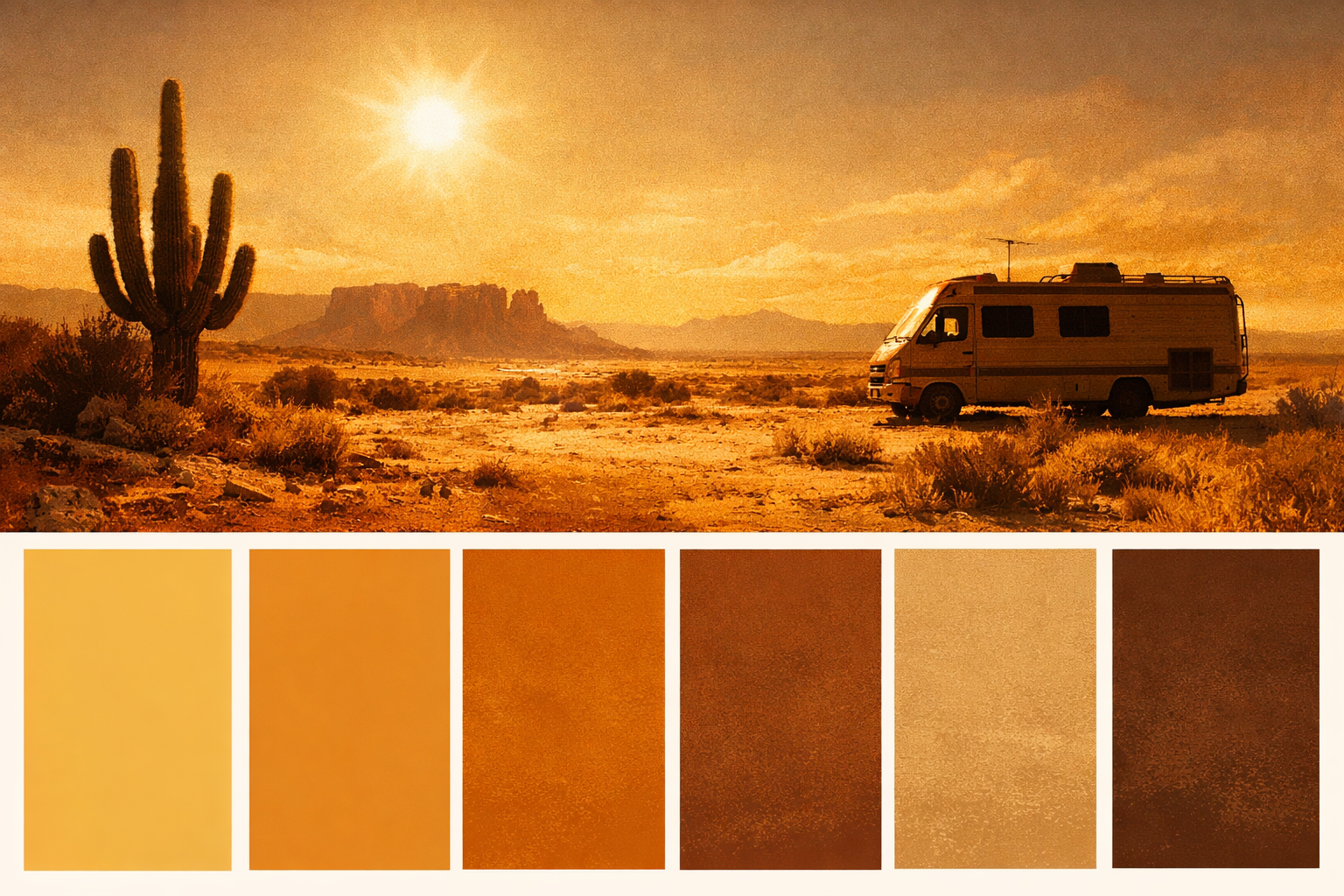
The show leans heavily into warm, sun baked hues. Yellows, ochres, dusty browns, and muted oranges dominate exterior scenes, creating a sense of heat, dryness, and exposure. These tones reinforce the idea that the characters are operating in an unforgiving environment where every decision carries weight. The color choices also heighten the contrast between the vast openness of the desert and the tight, controlled interiors where many of the show’s most tense moments unfold.
Light plays an equally important role. Midday sun is often used without softening, producing sharp shadows and high contrast. This approach gives outdoor scenes a raw, documentary like quality. The harshness of the light mirrors the moral pressure building on the characters, especially Walter and Jesse, who often find themselves isolated in these wide, empty spaces.
Interior lighting tends to be more controlled but still grounded in realism. Practical lights, fluorescents, and dim household bulbs create a sense of confinement. The shift from the bright desert to these darker, enclosed spaces reinforces the duality at the heart of the series: freedom versus entrapment, exposure versus secrecy.
For cinematic prompts, this palette and lighting style translate into clear visual cues. Warm earth tones, strong sunlight, long shadows, and wide horizons help evoke the show’s atmosphere without referencing it directly. The key is to balance natural light with the sense of isolation that defines many of the series’ most memorable scenes.
Iconic Environments and How to Recreate Them in AI
Breaking Bad is built around locations that carry mood and narrative weight. These environments are instantly recognizable because they combine strong visual identity with emotional tension. When translated into AI prompts, they work best when you focus on atmosphere, scale, and the physical details that define each space.
The desert is the show’s most defining environment. Its wide horizons, pale sand, scattered brush, and distant mountain lines create a sense of isolation that shapes the tone of many episodes. The harsh sunlight, long shadows, and heat haze contribute to a feeling of exposure. To recreate this in AI, emphasize open space, warm earth tones, and strong natural light. The goal is to capture the emptiness and vulnerability that the desert brings to the story.
Suburban interiors form a contrasting visual layer. These homes are quiet, modest, and grounded in everyday life. Soft indoor lighting, neutral walls, and simple furniture create a sense of normality that often clashes with the characters’ hidden conflicts. In prompts, focus on warm indoor tones, natural clutter, and a lived in atmosphere. These details help convey the tension between ordinary life and the pressure building beneath the surface.
Industrial spaces appear throughout the series and add a colder, more utilitarian mood. Warehouses, storage units, and abandoned facilities are usually lit with fluorescents or dim overhead fixtures. Concrete floors, metal beams, and repeating geometric patterns define these environments. When describing them in AI, highlight structure and texture: rigid lines, reflective surfaces, and the sense of a place designed for function rather than comfort.
Confined interiors are another recurring element. Basements, narrow hallways, and small offices create a feeling of compression. Low ceilings, limited light sources, and tight framing intensify the atmosphere. To recreate this in prompts, focus on restricted space, directional lighting, and the sense of being enclosed. These elements help build tension without referencing any specific scene.
Each environment in Breaking Bad carries its own emotional tone. By isolating the visual traits that define these spaces, you can create AI prompts that evoke the series’ atmosphere while remaining original and safe. Think in terms of light, space, and texture, letting the environment communicate the mood.
Describing “Blue Meth” Without Triggering AI Filters
One of the most recognizable visual elements associated with Breaking Bad is the bright blue crystalline substance that appears throughout the series. When creating cinematic prompts, however, naming it directly often triggers safety filters. The solution is to describe the object through its visual qualities rather than its real world meaning. This keeps the prompt safe while still capturing the aesthetic that viewers associate with the show.
The first step is focusing on color. The substance is known for its intense, translucent blue tone, so emphasize clarity and saturation. Words like “vivid,” “glass like,” “icy blue,” or “gem toned” communicate the look without referencing anything prohibited. Treat it as a mineral, a polished crystal, or a synthetic glass fragment rather than something chemical.
Texture is equally important. The material is usually shown as sharp, angular pieces with reflective surfaces. Describing it as “fractured blue crystals,” “irregular translucent shards,” or “jagged glass like fragments” captures the appearance accurately. These phrases are purely visual and safe for any AI system.
Light interaction is what gives this object its distinctive presence on screen. It often appears under strong artificial lighting, which enhances its clarity and color. You can describe how the shards catch the light, how reflections scatter across their surfaces, or how the blue tones glow when illuminated. This adds depth and realism without crossing any boundaries.
Context should also remain neutral. Instead of placing the material in a laboratory or any setting tied to illegal activity, use cinematic or abstract environments. A reflective metal table, a dark room with a single overhead light, a macro shot with shallow depth of field, or a minimalist still life composition all work well. These settings evoke the atmosphere without referencing anything restricted.
By focusing on color, texture, light, and composition, you can recreate the visual essence of the iconic blue crystals in a way that is safe, artistic, and fully compatible with AI systems. The result is an image that feels connected to the world of Breaking Bad while remaining entirely within acceptable creative guidelines.
Example Prompt:
“macro shot of vivid icy blue crystalline shards scattered across a reflective metal surface, sharp angular fragments with glass like transparency, intense blue tones glowing under a single overhead light, high contrast cinematic lighting, shallow depth of field, dramatic reflections, ultra detailed texture, 35mm photography style”

Character Archetypes and How to Translate Them Into Visual Language
Breaking Bad’s characters are defined by strong visual archetypes. Their physical traits, posture, clothing, and emotional tone create silhouettes that are instantly recognizable. When building AI prompts, the goal is to describe these traits in detail without referencing real actors. The following archetype prompts integrate complete physical descriptions, ensuring consistent and accurate generation.
Walter White — Early Phase
Early Walter appears modest, stressed, and physically unassuming. He looks like a man carrying quiet pressure.
Prompt:
“middle aged man in his late 40s to early 50s, slim build, slightly curved posture, tense shoulders, pale face with tired expression, light brown thinning hair, simple mustache, large metal frame glasses, insecure gaze, wearing beige or olive shirt, khaki pants, light jacket, standing in a modest suburban interior, warm household lighting, soft shadows, cinematic 35mm framing”
Walter White — Later Phase
Later Walter becomes visually severe and intimidating. His transformation is physical, emotional, and stylistic.
Prompt:
“middle aged man in his early 50s with a firm build, shaved head, neatly trimmed goatee, sun worn skin with subtle stress lines, cold calculating expression, piercing gaze, thin rectangular glasses, upright dominant posture, wearing a black jacket and dark shirt, strong contrast lighting, symmetrical cinematic framing, dramatic shadows, intense 35mm film look”
Jesse Pinkman
Jesse’s look is youthful, tense, and shaped by street culture.
Prompt:
“man in his late 20s with a slim agile build, short light brown hair or lightly shaved head, expressive eyes, tense jawline, youthful face marked by fatigue, restless posture, wearing oversized hoodie, loose jeans, sneakers, layered streetwear, standing in a dim cluttered urban interior, gritty textures, scattered light sources, moody cinematic atmosphere”
Gus Fring
Gus’s visual identity is defined by order and control.
Prompt:
“man in his mid 50s with medium build, impeccable posture, calm controlled movements, short well groomed hair, serene expression, minimal emotion, wearing discreet glasses, pressed suit with sober tie, standing in a clean symmetrical interior, balanced lighting, minimalist composition, quiet authority, cinematic realism”
Saul Goodman
Saul’s appearance is intentionally exaggerated and attention grabbing.
Prompt:
“man in his early 40s with medium build, slightly overweight, expressive face always in motion, wide confident smile, sharp eyes, brown hair slicked back with gel, wearing brightly colored mismatched suit and flashy tie, standing in a cluttered office, saturated colors, energetic posture, lively cinematic framing, 35mm film texture”
Hank Schrader
Hank’s presence is physical, confident, and straightforward.
Prompt:
“man in his late 40s with a robust build, broad shoulders, firm posture, strong jawline, direct focused gaze, short light brown or shaved hair, wearing casual agent clothing such as jeans and a simple shirt with badge visible, standing in bright daylight, wide open outdoor environment, crisp cinematic lighting”
Skyler White
Skyler’s visual identity blends elegance with constant internal pressure.
Prompt:
“woman in her late 30s to early 40s with a slender build, elegant posture, soft facial features with a concerned expression, analytical gaze, blonde shoulder length hair, straight or lightly wavy, wearing neutral toned domestic or professional clothing, standing in a lived in home interior, warm lighting, subtle tension, intimate cinematic framing”
Camera Angles, Framing, and the Visual Grammar of Breaking Bad
One of the reasons Breaking Bad feels so cinematic is its deliberate use of camera language. The series treats framing as storytelling: every angle, every distance, and every movement is chosen to reveal something about power, tension, or emotional weight. Understanding this visual grammar is essential for building prompts that capture the show’s atmosphere without referencing it directly.
The series frequently uses low angle shots to shift power dynamics. Characters framed from below appear dominant, threatening, or morally elevated. This technique becomes especially effective in moments of transformation or confrontation. In prompts, describing a low angle perspective adds intensity and authority to a character, making the viewer feel smaller within the scene.
High angle shots serve the opposite purpose. They make characters look vulnerable, overwhelmed, or exposed. These angles are often used in wide desert scenes, where the environment dwarfs the figure. When translated into AI, high angle framing helps communicate fragility or emotional pressure.
The show also relies heavily on wide shots to emphasize isolation. A single character standing in a vast landscape creates a sense of emptiness and moral distance. These compositions use negative space to highlight internal conflict. In prompts, wide framing with large empty backgrounds instantly evokes this mood.
Close ups are used sparingly but with precision. When the camera moves in tight, it’s usually to capture a moment of emotional fracture or intense decision making. The lighting becomes harsher, shadows deepen, and the viewer is forced into the character’s internal world. Describing close ups in prompts adds intimacy and psychological tension.
Another signature technique is the use of unusual camera placements—inside objects, behind transparent surfaces, or from extreme perspectives. These shots create a sense of voyeurism or mechanical detachment. They remind the viewer that the world is full of hidden angles and unseen consequences. In prompts, referencing “unconventional camera placement” or “object mounted perspective” helps recreate this distinctive style.
Finally, the series often uses static shots to build tension. The camera doesn’t move; the scene breathes on its own. Stillness becomes a form of pressure. In contrast, slow, deliberate camera movements—like creeping dolly shots—signal that something is shifting beneath the surface. When describing these choices in prompts, think in terms of emotional pacing: stillness for dread, slow movement for anticipation.
Together, these techniques form a visual language that is both restrained and expressive. By integrating angle, distance, and movement into your prompts, you can create images that feel cinematic, intentional, and emotionally charged—echoing the spirit of Breaking Bad without ever copying it.
How to Write Prompts in the Breaking Bad Style
Writing in the Breaking Bad style becomes much easier when you follow a simple structure. Instead of trying to describe everything at once, you build the scene step by step. The method I use is straightforward and works consistently well:
Subject → Camera → Lighting → Mood → Environment
This keeps the prompt focused and cinematic. You’re not listing random details; you’re shaping a moment with intention. Once you choose the emotional direction of the scene, the rest follows naturally.
Start with the subject, not as a portrait but as a presence. Think posture, tension, expression, energy. Then choose the camera, because the angle decides how the viewer relates to the character. After that, define the lighting, which sets the emotional temperature. Add the mood, the feeling that ties everything together. And finally, place the scene in an environment that reinforces the emotion rather than distracting from it.
When you follow these five steps, the prompt stops feeling like a technical description and starts feeling like a shot from a story. That’s the essence of the Breaking Bad style: intention, tension, and atmosphere.
Practical Examples Using the Five Step Method
Below you can inspire yourself using the formula Subject → Camera → Lighting → Mood → Environment.
Example 1 — Desert Tension
Subject: middle-aged man with tense posture and tired eyes Camera: low-angle wide shot Lighting: harsh midday sun with long shadows Mood: quiet slow-burning tension Environment: vast empty desert road with distant mountains
Full Prompt:
“middle-aged man with tense posture and tired eyes, low-angle wide shot, harsh midday sun casting long shadows, quiet slow-burning tension, vast empty desert road with distant mountains, cinematic realism”
Example 2 — Suburban Pressure
Subject: woman in her early 40s with a worried gaze Camera: medium shot Lighting: soft warm indoor light Mood: subtle emotional pressure Environment: modest suburban kitchen with natural clutter
Full Prompt:
"woman in her early 40s with a worried gaze, medium shot, soft warm indoor lighting, subtle emotional pressure, modest suburban kitchen with natural clutter, cinematic framing”
Example 3 — Industrial Confrontation
Subject: man with analytical expression and rigid posture Camera: low-angle medium shot Lighting: pale overhead fluorescents Mood: controlled tension Environment: abandoned warehouse with concrete floors and metal beams
Full Prompt:
“man with analytical expression and rigid posture, low-angle medium shot, pale overhead fluorescent lighting, controlled tension, abandoned warehouse with concrete floors and metal beams, cinematic realism”
Example 4 — Emotional Close-Up
Subject: young man with tired eyes and a tense jaw Camera: tight close-up Lighting: dim interior light falling across half his face Mood: quiet emotional weight Environment: background fading into darkness
Full Prompt:
“young man with tired eyes and a tense jaw, tight close-up, dim interior light across half his face, quiet emotional weight, background fading into darkness, cinematic depth”
Example 5 — Nighttime Suspense
Subject: lone figure standing beside an old car Camera: wide shot Lighting: cold blue streetlights Mood: atmospheric tension Environment: nearly empty parking lot with wet asphalt
Full Prompt:
“lone figure standing beside an old car, wide shot, cold blue streetlights, atmospheric tension, nearly empty parking lot with wet asphalt, cinematic mood”
Example 6 — Object-Mounted Perspective
Subject: man reaching toward the camera Camera: object-mounted POV from inside a transparent container Lighting: harsh overhead light creating reflections Mood: uneasy anticipation Environment: blurred industrial background
Full Prompt:
“man reaching toward the camera, object-mounted POV from inside a transparent container, harsh overhead light with reflections, uneasy anticipation, blurred industrial background, cinematic tension”
Conclusion: Bringing the Breaking Bad Style Into Your Creative Workflow
Working with the Breaking Bad aesthetic isn’t about copying scenes or characters. It’s about understanding why the images feel the way they do and using that intention in your own work. Once you internalize the logic behind the visuals — the tension, the silence, the weight of the environment — the style becomes something you can apply naturally.
The Five Step Method is the simplest way to keep that consistency. Subject → Camera → Lighting → Mood → Environment This structure forces you to think like a director instead of a technician. You’re not stacking adjectives; you’re shaping a moment.
The more you practice, the more instinctive it becomes. You start to feel when a scene needs a low angle, when the light should be harsh, when the environment should overwhelm the character. And that’s the point: the style stops being a reference and becomes a tool you can adapt to any project.
Use the prompts from the previous chapter as a starting point, tweak them, break them apart, rebuild them. The Breaking Bad aesthetic works because it’s intentional, not because it follows a formula. The formula simply helps you get there faster.
If you keep the emotional core in mind — tension, silence, pressure, isolation — the images will naturally carry the same cinematic weight that made the series unforgettable.
Try the Cinematic Prompt Builder
Create your own cinematic prompts with our free builder.
Try the prompt builderContinue Reading
- The Science Behind Cinematic Prompts: Why Camera, Lighting, and Composition Matter in AI GenerationAn in-depth analysis of how diffusion models interpret camera, lighting, and com
- Detail Enhancement Strength: The Setting That Can Make or Break Your AI ImagesDetail Enhancement Strength is one of the most overlooked yet impactful settings