

From Post Nuclear RPG to Global TV Phenomenon
Fallout began long before it became a prestige television series. The franchise started in 1997 with the release of the first Fallout game, developed by Interplay Productions. It introduced a world shaped by retro futurism, atomic age optimism and nuclear devastation. The game quickly became a cult classic, praised for its open ended storytelling, moral complexity and distinctive atompunk aesthetic. Over the years, the series expanded under Bethesda Game Studios, evolving into one of the most influential RPG franchises in the world, with titles like Fallout 3, New Vegas and Fallout 4 reaching massive global audiences.
The universe of Fallout stood out because it blended 1950s Americana with advanced technology, then shattered it all under the weight of nuclear war. This contrast created a visual identity that was instantly recognizable, and it became one of the reasons the franchise maintained relevance for more than two decades. By the time Amazon announced a live action adaptation, Fallout was not just a game series, it was a cultural landmark.
The television adaptation, produced by Kilter Films in collaboration with Bethesda, was developed by Geneva Robertson Dworet and Graham Wagner. Directed in part by Jonathan Nolan, the series premiered on Amazon Prime Video in 2024. It received strong critical reception, praised for its worldbuilding, production design and faithful translation of the franchise’s tone. The show managed to capture the spirit of the games without copying them, creating a version of the wasteland that felt both familiar and new.
This transition from video game to television worked because Fallout already had a rich visual language. The show embraced that identity, using it as a foundation for a world that feels lived in, broken and strangely nostalgic. For anyone working with AI prompts, this combination of strong aesthetics and clear thematic identity makes Fallout one of the most rewarding universes to recreate.
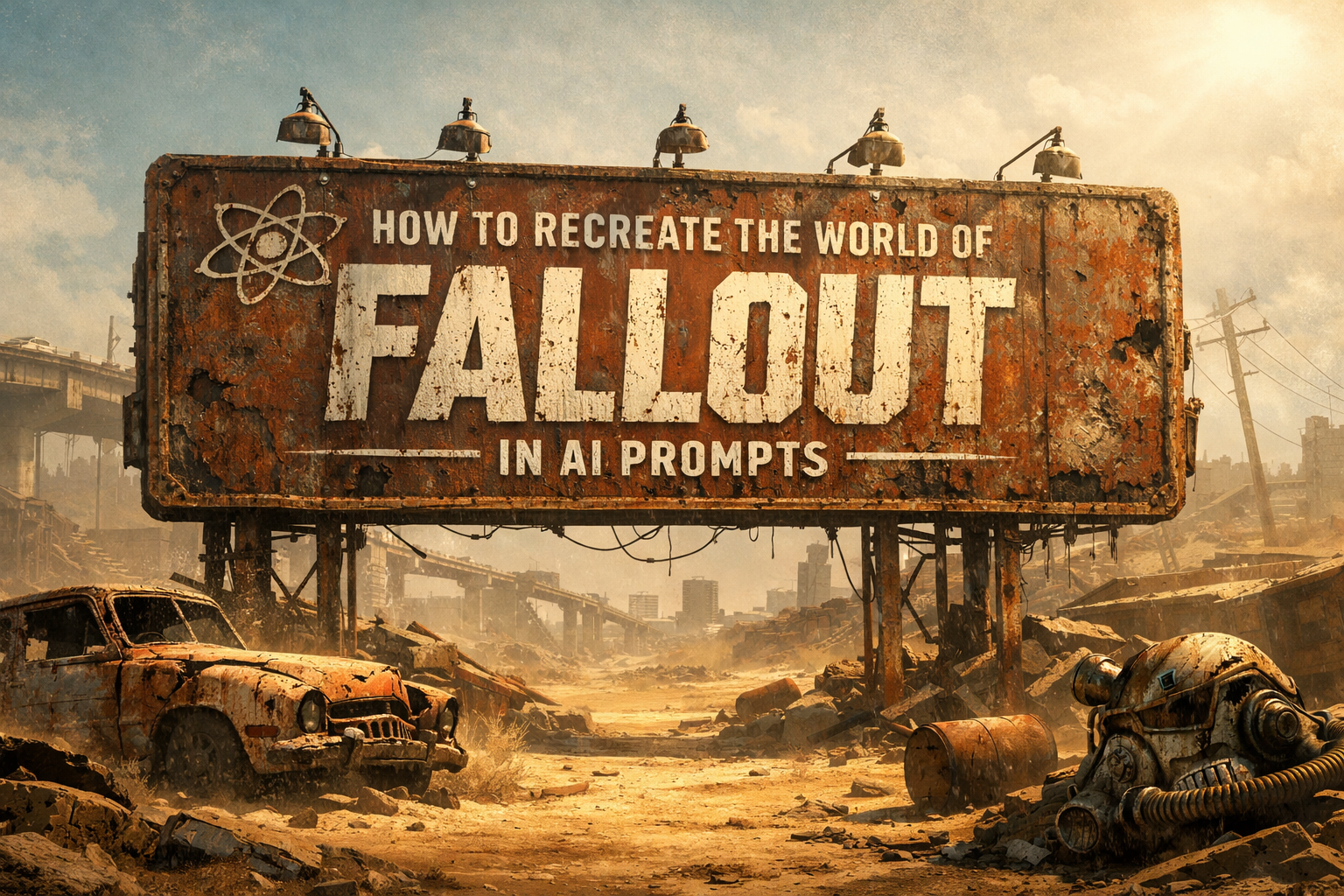
Defining the Fallout Aesthetic, Retro Futurism in Ruins
Before the bombs fell, the world of Fallout was already different from ours. The timeline diverged after the 1940s, creating a society that kept the culture, design and optimism of mid century America while pushing technology far beyond what existed in the real 1950s. This means the retro futuristic look was not a product of the apocalypse, it was already the world’s identity. Nuclear power fueled cars, robots assisted households, computers were advanced but still bulky and analog, and consumer technology followed the rounded shapes and chrome finishes of the atomic age. When the Great War destroyed everything, it froze that aesthetic in place, leaving a future that looks like a past that never happened.
This contrast defines Fallout. You see outdated televisions beside energy weapons, rusted sedans beside nuclear powered armor, cheerful pre war posters peeling off irradiated walls. The world feels familiar, yet fundamentally wrong, because it blends nostalgia with devastation. Fallout is not simply post apocalyptic, it is a re imagined modernity, a future built on the dreams and anxieties of the 1950s, then shattered by nuclear fire.
What feels old in Fallout comes from mid century Americana. Rounded appliances, pastel colors, chrome trims, analog dials, patriotic slogans and atomic optimism. What feels futuristic comes from exaggerated engineering, oversized machinery, nuclear batteries, robotic assistants and technology that is advanced but still visually rooted in the 1950s. Everything is heavy, industrial and slightly naive, as if progress happened without cultural evolution.
This retro futuristic identity places Fallout in a category often described as atompunk, a style defined by atomic power, industrial design and the tension between optimism and annihilation. Fallout takes that aesthetic and pushes it into decay, creating a world where the past and the future coexist in ruins.
Describing this universe requires vocabulary that captures both sides of the equation. Terms like irradiated Americana, atomic retro, industrial decay, retro futuristic machinery, analog technology, nuclear wasteland and pre war nostalgia help define the tone. These words will become essential later when we translate the aesthetic into AI prompts, because they communicate not only what the world looks like, but how it feels.
Fallout’s identity is built on this tension between what was promised and what survived. It is a world shaped by hope, destroyed by war and preserved in fragments. Understanding this contrast is the foundation for recreating the universe in AI, because every prompt begins with a clear sense of what defines the world visually and emotionally.
Why the Fallout TV Show Is a Goldmine for AI Prompting
The show works unusually well in AI because its visual identity is bold, readable and consistent. It embraces strong shapes, clear silhouettes and instantly recognizable materials — all things AI models interpret with precision.
• Textures like rust, dust, cracked concrete and scorched metal translate extremely well into prompt language.
• Retro futuristic technology — wrist terminals, exosuits, analog consoles — gives you a flexible vocabulary that models understand.
• Varied environments (vaults, wasteland, ruins, settlements) allow you to create many different scenes without losing coherence.
• Character archetypes (vault dwellers, ghouls, raiders, rangers) have clear silhouettes and worn, textured gear.
The show gives you structure: materials, lighting, props, environments and camera logic that all work together. When a universe has this level of visual coherence, prompting becomes direction — not guesswork.
The wasteland is full of elements that AI models interpret with precision. Rusted metal, cracked concrete, broken neon and dusty landscapes all translate cleanly into prompt language. These surfaces have texture, and texture is one of the things AI understands best. When you describe oxidation, peeling paint or scorched metal, the model knows exactly how to respond. Fallout’s world is built on these materials, which gives you a natural advantage when prompting.
Characters also help. Vault dwellers, ghouls, raiders and rangers all have clear silhouettes and recognizable gear. Their clothing is practical, worn and textured, which makes them easy to describe and easy for AI to render. Even without naming specific characters, you can evoke the archetypes through clothing, posture and environment.
Fallout succeeds in AI because it gives you structure. It gives you materials, lighting, props, environments and character types that work together. When a universe has this level of visual coherence, prompting becomes less about guessing and more about shaping. You are not fighting the model, you are guiding it through a world that already has rules.
This is why Fallout is such a rewarding playground for creators. It offers a strong identity, but it also leaves space for your own interpretation. You can follow the show’s logic, or you can push it into new directions, and the result still feels authentic. For anyone working with AI, that combination is rare.
The Visual DNA of Fallout: Ruin, Retro Futurism, Contamination
The series is built on three visual pillars:
Ruin
Cities collapsed and never recovered. Highways are fractured, vehicles rust in place, neighborhoods sit half buried in dust. Ruin is not decoration — it is the environment.
Retro Futurism
A 1950s vision of the future: rounded shapes, chrome surfaces, analog dials, nuclear powered machinery. Advanced yet unmistakably mid century.
Contamination
Not stylized green fog, but subtle glows, scorched surfaces, irradiated pools and atmospheric color shifts. A constant sense of danger without exaggeration.
Together, these pillars create a world that is instantly recognizable — and extremely prompt friendly.
Color and Texture: Dust, Rust, Oxidation and Nuclear Glow
The show’s palette is dry, sun bleached and permanently weathered.
• Dust softens edges and pushes colors toward warm earth tones.
• Rust adds deep oranges and reds to abandoned metal.
• Oxidation stains surfaces with greens and blues.
• Radioactive glows appear sparingly as atmospheric accents.
These textures tell a story of neglect, survival and contamination. In AI prompts, they provide clear material cues that models interpret with precision.
Lighting the Wasteland: Harsh Sun, Dust Haze, Broken Neon
Lighting shapes the emotional tone of the series.
• Harsh sunlight dominates exteriors, flattening shadows and revealing every imperfection.
• Dust haze and heat distortion create depth without relying on stylized radioactive fog.
• Broken neon introduces unstable color accents in settlements and ruins.
The sun reveals, the haze softens and the neon remembers. This lighting grammar gives the show its emotional range — and gives your prompts cinematic clarity.
Environmental Storytelling: Ruins, Vaults, Highways, Settlements
Every environment in the series carries history.
Ruins
Collapsed buildings, cracked storefronts, rusted cars, faded advertisements. A world frozen mid collapse.
Vaults
Sterile, pastel, rounded, analog. Safe yet unsettling.
Highways
Broken concrete skeletons stretching across the landscape. A reminder of a world built for movement that no longer exists.
Settlements
Improvised, messy, functional. Scrap metal walls, patched roofs, flickering lights — survival through necessity.
These spaces are not backgrounds. They are narrative tools.
Props and Iconography: Wrist Terminals, Retro Bottles, Exosuits, Posters
The show’s props are functional, worn and iconic.
• The wrist mounted computer: bulky, analog, monochrome.
• The retro soda bottle: sculptural, nostalgic, dusty.
• The exosuit: heavy, industrial, militaristic.
• Propaganda posters: patriotic, faded, torn.
These objects anchor the viewer in the world’s logic and give your prompts emotional weight.
Camera Grammar: Wide Shots, Close Up Grit, Retro Tech Inserts
The series uses a clear cinematic rhythm:
• Wide shots show scale and emptiness.
• Close ups reveal texture and emotion.
• Insert shots isolate analog tech.
• Medium shots balance character and environment.
Using this grammar in prompts transforms images from random compositions into scenes that feel like part of a world.
Ready to Use Prompt Structures for Fallout Style Imagery
The show’s visual language is modular, making it ideal for prompting.
Wasteland Base
subject in a sun bleached wasteland, fractured highways, distant ruins, dust haze, rusted debris, harsh sunlight, wide establishing shot
Vault Interior
subject inside a sterile retro industrial bunker, pastel walls, analog consoles, flickering lights, narrow corridor, mid shot
Settlement
subject in a scrap built settlement, patched roofs, hanging cables, flickering neon, dusty atmosphere, warm practical lighting
Scavenger Close Up
subject wearing worn survival gear, patched fabric, rusted tools, gritty close up, harsh side lighting
Retro Tech Insert
close up of analog device, blinking lights, mechanical switches, dust particles, dramatic insert shot
Exosuit
subject wearing heavy nuclear powered exosuit, thick plating, exposed hydraulics, oxidized surfaces, low angle cinematic shot
These structures give you clean, coherent prompts that feel authentically Fallout.
Conclusion: Building Your Own Wasteland
Fallout works because it gives you a world with rules, history and identity. The series shows a wasteland shaped by ruin, retro futurism and the long shadow of nuclear ambition, mas nunca limita a imaginação. It offers a foundation, not a cage. That is why it translates tão bem para prompting: the universe is strong enough to guide you, but open enough to let you create something new.
When you understand the pillars of the aesthetic, you stop copying Fallout and start speaking its visual language. You know how the sun hits the ruins, how dust hangs in the air, how analog technology survived the end of the world and how settlements grow from necessity. You know how the camera observes the wasteland, how props carry history and how textures tell stories. With this knowledge, you can build scenes that feel authentic without relying on direct references.
The goal is not to recreate the series frame by frame. The goal is to build your own wasteland. Use the templates, the structures and the vocabulary, but let your imagination fill the gaps. Maybe your world has different ruins, different vaults, different survivors. Maybe your wasteland is brighter, darker, more hopeful or more desperate. Fallout gives you the grammar, but you choose the sentences.
AI prompting becomes powerful when you stop thinking in isolated images and start thinking in worlds. A world has rules, materials, lighting, props, moods and camera logic. When you combine these elements with intention, your images gain coherence and emotional weight. They stop looking like random generations and start looking like scenes from a universe that exists beyond the frame.
Fallout is a guide, not a destination. It teaches you how to mix nostalgia with decay, how to balance realism with retro futurism and how to use texture and light to tell stories. Once you understand these principles, you can apply them to any world you create, whether it is post apocalyptic, sci fi, atompunk or something entirely your own.
The wasteland is yours now. Build it with purpose, shape it with detail and let it grow into something that carries your voice. The tools are here, the structures are clear and the aesthetic is ready to be explored. Everything that comes next belongs to you.
Try the Cinematic Prompt Builder
Create your own cinematic prompts with our free builder.
Try the Tool